
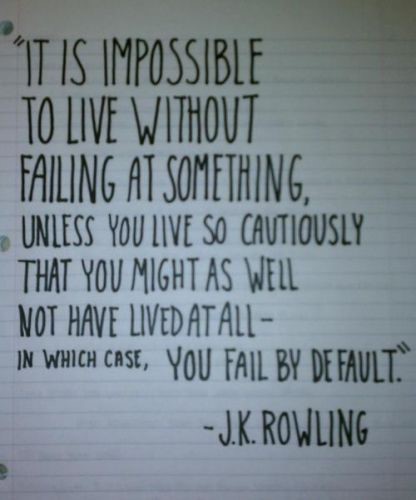
Professional failing

by Jeto (Student Blogger: BSc Psychology (Lancaster University Ghana)

Fail as many times as possible! You should get used to the concept of failing. Failing is something you can’t avoid. There is no need for me to remind you of great minds such as Thomas Edison and Albert Einstein who are famous for making many mistakes and failing terribly before eventually succeeding. These are stories we’ve heard before. No matter how smart or careful we might be, we are all going to fail. We either fail at something or we fail to do something. So get used to the concept of failing, just as you’ve got used to breathing, because failing is the prerequisite for success.

This is the hard truth I have had to learn for the most part of my life and I am going to tell you how to become a professional at failing.

I don’t know if you can relate to this, but every time I wrote an exam, my parents would always ask me how the exam had been and I would say “fine”. But every time it came to the end of the term, I was always scared out of my mind because I thought I’d perform badly – and I always did, every single time. I would get woeful results, then always tell myself that it was the last time, that I would make sure I put in my best and do better the next year, but that never happened. All through my primary and secondary school, it was normal for me to fail. In fact, at one point I was no longer worrying about whether or not I failed, but how badly I failed.

However, after I left secondary school, there was a turn around. All of a sudden I was no longer worrying about how badly I failed but rather how well I passed. I went from being at the very bottom of the class to being at the very top, not because my classmates were not very smart, but because I became better at learning. I went from struggling to be a C student to being an A student, from the class jester to the class representative and president of the Psychology Association in Lancaster University Ghana – all of which happened because I came to one realization: failing isn’t the same thing as failure. Failing is a journey towards success, while failure is a destination at the opposite end of success. Failing is when you keep trying until you succeed, while failure is when you quit after failing. So this is my advice:

  • Never mistake failing for failure.
  • Never be scared to fail, because it’s the only way to succeed.
  • Never give up. Keep failing until you succeed.
  • Finally, get used to the concept of failing but don’t get comfortable failing. Never forget that the goal is to succeed!


This is how to become a professional at failing – until you succeed.

 

Failure is cool…

by Kofi (Student Blogger: BA Law (Lancaster University Ghana) 

The general perception of failure is negative. Why not? We are accustomed to attaching a negative connotation to it and it’s just not glamorous. When we think failure, we think of shame and humiliation. What will my friends think of me? Will anyone spot or make me out in the re-sit examination hall? These thoughts rush through our minds and leave us feeling low with defeat and hopelessness. I know this because I’ve faced it too and from time to time still experience it. Hey, I never said I was perfect.

We tend to focus more on the negative aspect of failure than the positive – but it doesn’t have to be that way! That’s why I thought I’d share my approach on how to deal with failure in school, be it coursework submission or an examination paper:

Breathe. The first step is to breathe. It’s not the end of the world, relax. Don’t beat yourself up. Take your mind off it by doing something that makes you happy and sane. My go-to in this case is my music. I have a playlist for every occasion and at this time my ‘YOU CAN DO IT’ playlist comes in handy. I listen to my music and it empowers and assures me that I’m more than a failure and sometimes you just have to lose to win again. This is not you trying to forget the failure but rather just a temporary escape to ease your mind. Again, as Jay Z puts it: ‘You learn more in failure than you ever do in success’.

Inquire and note what went wrong. Lecturers are not there to fail us purposely and the belief that they delight in dishing out F grades is inaccurate. However, if the quality of work submitted is not up to standard, they will have to give you what you deserve, which is better than they misleading you with a good grade. Once you talk to the lecturer about it and understand why you got a bad grade, you’ll never repeat the same mistakes again because you understand now. This is often the most difficult part of the post-failure process, because it requires you to look your failure in the face and note your mistakes.

Learn from the experience. Every experience is a learning curve whether pleasant or not. Reflection after failing is vital. Ask yourself critical questions like: Why did I fail? What went wrong? Did I start revising too late? Did I really understand what was taught in class? Answering these questions gives you insight to the way forward for you. Reflecting on the experience gives you the ins and outs of the situation. It also helps you take steps to avoid making the same mistakes. For instance, in the case of it being a bad grade in an examination, you just have to step up and change the prepping routine you used before; for example, you can start preparing for exams 6 weeks prior to it.

Above is how I normally deal with failure. The more I encounter failure, the more I learn, grow and improve. This doesn’t mean we should plan and settle for failure. Basically, all I’m trying to say is when you invest time and effort into assignments and the grade that follows is unexpected, it should be a learning experience. ‘When life gives you lemons, make lemonade’!