Dr Hannah Stewart was invited to speak about children’s hearing, listening, and cognition at BAA this year. BAA is always an energising and buzzing conference, and it was fantastic to catch up with so many familiar faces and to meet lots of new audiologists and industry colleagues too.
Brandon, Megan and Kat, recently attended the AudiDev25 workshop in Brussels (Belgium). This two day workshop focused on how humans develop hearing and make sense of sound. Because it was a more specialised European event, it felt much more personal than large international conferences, with plenty of time to chat and connect. The long poster sessions at which we all presented our latest projects, was really relaxed and made it easy to meet other researchers and hear about their latest work. The day before the workshop, Megan and Kat had a one-to-one session with Dr Axelle Calcus (the Brussels Auditory Neuroscience Group Lead), who gave us an introduction to analysing EEG data (a method for measuring brain activity). We were based in the Centre for Research in Cognition and Neuroscience getting a feel for what postdoctoral research life is like in Université Libre de Bruxelles. Of course, we also found time to explore Brussels and enjoyed plenty of free chocolate samples along the way. Overall, AudiDev25 was a friendly, engaging and inspiring experience.
Here a link to Bang (also a cute webite: https://www.bang.ulb.be/)
In September, our postdoctoral researcher Brandon presented a proposed analysis poster at the fNIRS UK Conference at Cambridge. Functional Near Infrared Spectroscopy (or fNIRS for short!) is a developing technique used to measure brain activity safely with infrared light. At the conference, Brandon and Dr Hannah Stewart attended multiple collaborative workshops and talks to learn more about how this state-of-the-art technology can be used in our classroom-based research. From the development of community-driven inclusion guidelines in fNIRS research, to new frameworks for data analysis – this knowledge exchange will undoubtedly strengthen the integrity of our fNIRS research in The PELiCAN Lab.
Want to know more about the conference? You can find the programme here.
We headed to Dublin, Ireland for the annual FLUX Congress – a major international meeting on developmental cognitive neuroscience, where researchers, clinicians and educators come together to share new discoveries and support the next generation of scientists. Brandon and Kat both presented posters. The conference was big, broad and brilliantly organised, with talks covering all areas of how the brain develops. A highlight was bumping into familiar faces including Kat’s former PhD supervisor, now based in New Zealand. A perfect reminder of how these global conferences help bring researchers together. We also made the most of being in Dublin, exploring the city in between sessions. Overall, FLUX 2025 was energetic, inspiring and a great chance to reconnect with the international research community.
Dr Hannah Stewart was joined by ten deaf children and young people in London for the final step of the James Lind Alliance Priority Setting Partnership for Childhood Deafness and Hearing Loss project. Working with our fantastic facilitators, Dr Dee Hennessy and Lesedi Vine, the group collaborated to agree the top ten future research priorities. The whole team felt an enormous sense of pride at the end of the day’s session – the children and young people had worked incredibly hard to reach this final stage, especially on such a hot day!
In July, Dr Hannah Stewart presented the method and preliminary results from the James Lind Alliance Priority Setting Partnership for Childhood Deafness and Hearing Loss project at the International Congress on the Education of the Deaf in Rome. She delivered the talk alongside Lucy Armstrong, one of the project’s steering group members, who brings valuable lived experience of deafness to the work. It was incredible to be part of such an accessible conference, where both sign and speech were used throughout.
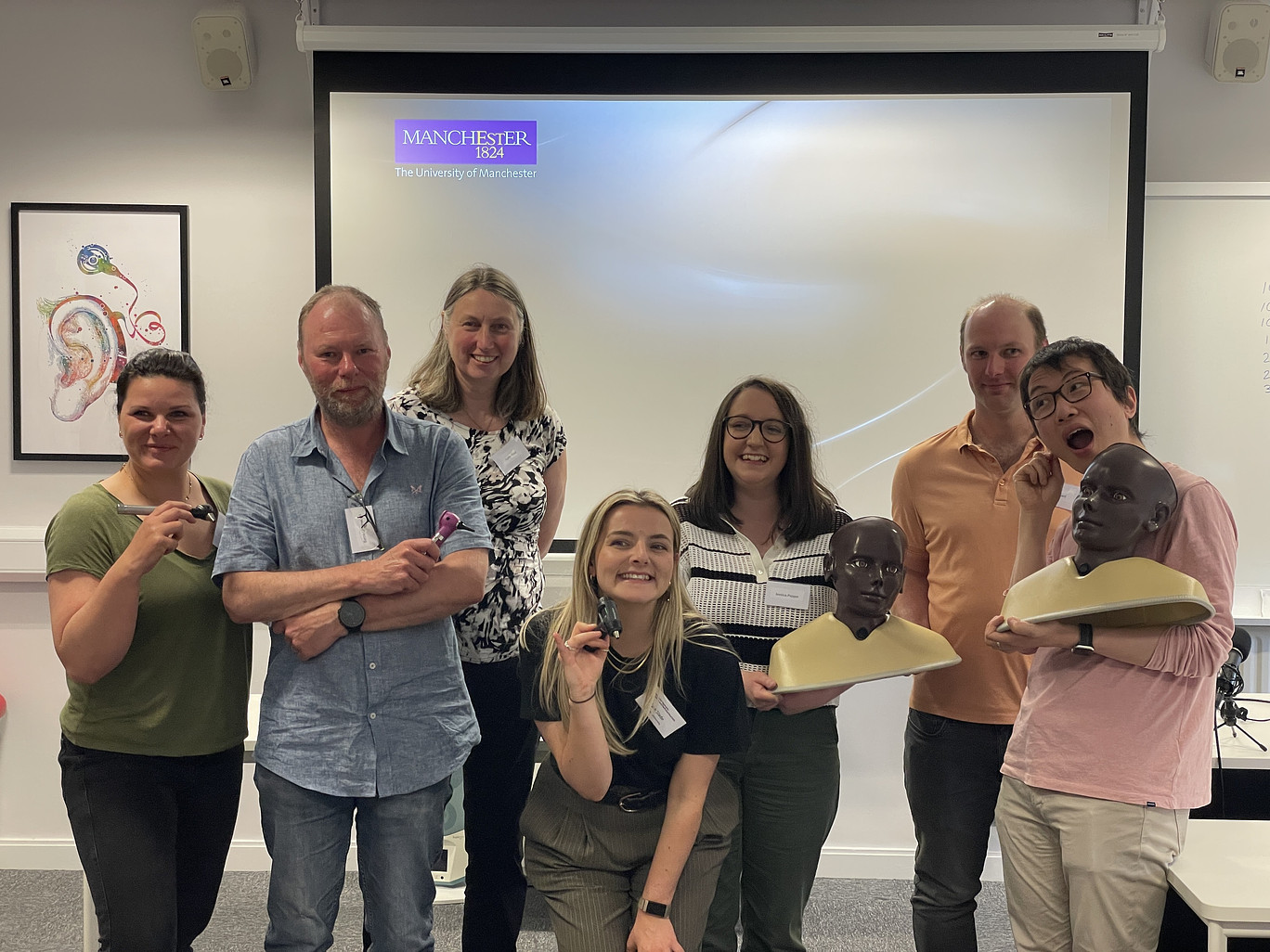
Advancing hearing and hearing loss across the North-West: A group from Lancaster’s Auditory Neuroscience Network group visited the Manchester Centre for Audiology and Deafness (ManCAD), where we were warmly welcomed and introduced to the centre’s impressive facilities for research and teaching, focusing on their specialist facilities for hearing and hearing loss. We were introduced to clinically rated sound-treated booths, used for both adult and paediatric studies, laboratory spaces for research and teaching, and two immersive VR simulations exploring human behaviour under auditory and visual impairments. The visit concluded with an opportunity to practice our otoscopy skills under expert supervision. The visit provided valuable insight into ManCAD’s integrated approach to research and training, and their close links with the NHS and medical research centres. We look forward to exploring future opportunities for collaboration across the North-West.
Kat, our postdoctoral researcher, had the fantastic opportunity to attend this year’s BATOD-BAEA Conference in Exeter, hosted by The Deaf Academy. The national event brought together around 100 professionals in Deaf education from across the UK, providing a valuable platform for sharing expertise, research, and the latest developments in assistive technology and inclusive teaching. Organised by the British Association of Teachers of Deaf Children and Young People (BATOD) and the British Association of Educational Audiologists (BAEA), the conference fostered collaboration and innovation in the field.

This year’s Speech in Noise (SpiN) Workshop was held in HiOne at Lancaster University! Chaired by Lancaster University’s Dr Helen Nuttall and Dr Hannah Stewart, the roster of remarkable topics ranges from ‘language acquisition with cochlear implants’ to ‘speech-in-noise impairments in Alzheimer’s disease dementia’. With over 120 auditory scientists from Manchester to Japan, the conference is proving a triumphant collaboration in the field of speech and hearing research. Find out more out the programme and speakers here.