Tag Archives: youth

Using creative spaces to foster empathy for small-scale fishing communities in Kalibaru Timur, Cilincing

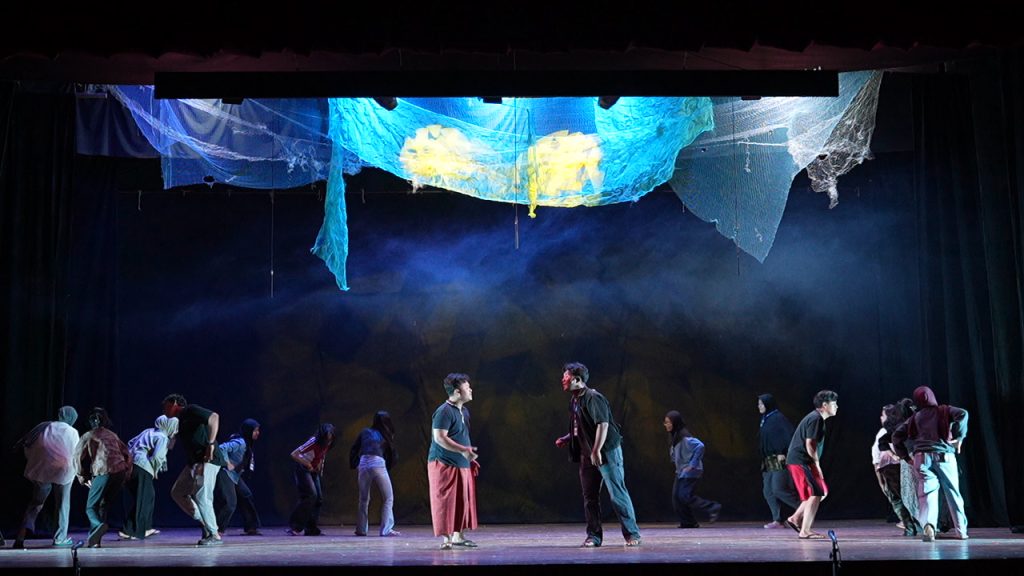
Photo Credit: Sanko Yannarotama (Yayasan Segara Nusa Nawasena)

On the 23rd of July 2026, twenty young people from Cilincing coastal communities visualised their communities’ lived experience and their aspirations for an inclusive and sustainable blue economy processes through ‘Laut Kita, Masa Depan Kita (Our Ocean, Our Future)’ participatory theatre performance in Jakarta, Indonesia. The UK Research and Innovation (UKRI) Arts and Humanities Research Council (AHRC) Impact Acceleration Account (IAA) funded “Laut Kita, Masa Depan Kita” is part of a sustained collaboration between Lancaster University, Pusat Riset Hukum Badan Riset dan Inovasi Nasional (BRIN) and Yayasan Segara Nusa Nawasena under the Leverhulme funded ‘Ocean justice and the blue economy’ research project.Some of the young people who took part in the theatre performances come from small-scale fisher and fishworker families who have never received any theatre training. The training for young people in performing, directing, and playwriting was delivered by a local art collective, Insani Teater Cilincing in close collaboration with researchers from Lancaster University, BRIN, and Yayasan Segara Nusa Nawasena.

The series of two ‘Laut Kita, Masa Depan Kita’ musical theatre performances brought together over 100 people from local (e.g. Cilincing urban village office (Kelurahan)) and national government bodies (e.g. the Ministry of Marine Affairs and Fisheries), civil society organisations (e.g. Kalibaru Timur Small-Scale Fishers’ Cooperative), media (e.g. TVRI), and academics and students.  Drawing from the research findings and innovative practices from ‘Ocean justice and the blue economy’ project the play creatively depicted the economic, social, and health challenges faced by Cilincing small-scale fishers, fishworkers and their communities; injustices that they felt particularly due to pollution and climate change; and community led initiatives to shape a sustainable future (e.g. recycling of green mussel shells through Komunitas Cangkring).

Head of Research Center for Law, Badan Riset dan Inovasi Nasional (BRIN), Dr Nawawi Asmat, noted that the theatre performance is ‘a unique way in the dissemination of research findings’ as it served as useful tool in ‘translating scientific findings into the language that could be more easily understood’ by the general public.

Special Advisor to the Minister of Maritime Affairs and Fisheries, Dr Hendra Yusran Siry, further explained that ‘artistic method such as theatre could generate empathy’ and ‘open the avenue for dialogue’ between communities who are dependent on the ocean including small-scale fishers, fishworkers, young people, and women with public and private stakeholders.

Creating a participation space for youth
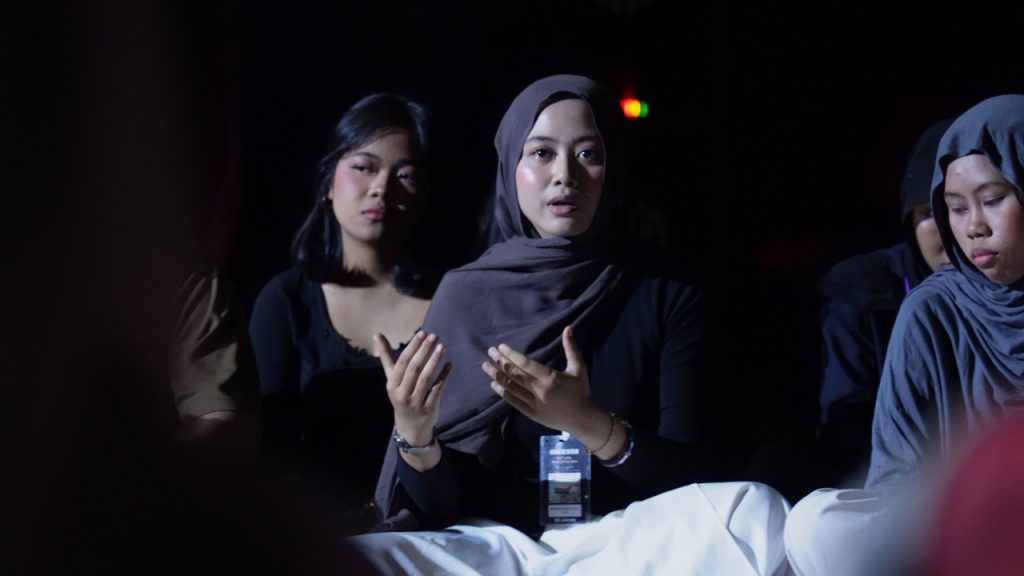
Photo credit: Sanko Yannarotama (Yayasan Segara Nusa Nawasena)

Youth between the age of 15 and 35 accounts for one-third of the world’s population’ (European Youth Forum, 2024; UNFCCC, 2025). Yet, according to the Executive Director of Yayasan Segara Nusa Nawasena, Nathania Giovanni, ‘when it comes to ocean governance, it is not immediately clear to young people how to voice their concerns or what it means for them to meaningfully participate in blue economy processes. This is highly problematic as ocean degradation and climate change coupled with biodiversity loss disproportionately impacted youth right to life, food, and development’.

During discussion with community leaders and audience that follow the theatre performance, Dr Laely Nurhidayah, BRIN, further noted the pressing need for enhancing youth participation in shaping sustainable blue economy is timely and important ‘due to poverty, lack of training job and education opportunities, and fierce competition over space – for instance due to competing ocean economy sectors and the growing illegal settlement on the coastline’.

Dr Senia Febrica, Research Associate at Lancaster University emphasised that the purpose of the co-development of the ‘Our Ocean, Our Future’ is to create ‘a participation space for youth from SSF community in Cilincing that are often sidelined in the blue economy processes and empower youth to enhance their ability to engage with varied and relevant ocean stakeholders’. Creative methods through visual expressions and participatory theatre embedded in ‘Ocean justice and the blue economy’ research project therefore play an important role in providing coastal communities with a tool to document their own experience and ensuring that traditionally overlooked stakeholders including youth are at the centre of ocean research and dissemination processes.

A documentary film based on the theatre co-development and performance is currently being produced and it will be made available in our project website.
Ocean Justice – towards a diverse and inclusive marine and coastal sector

By Senia Febrica

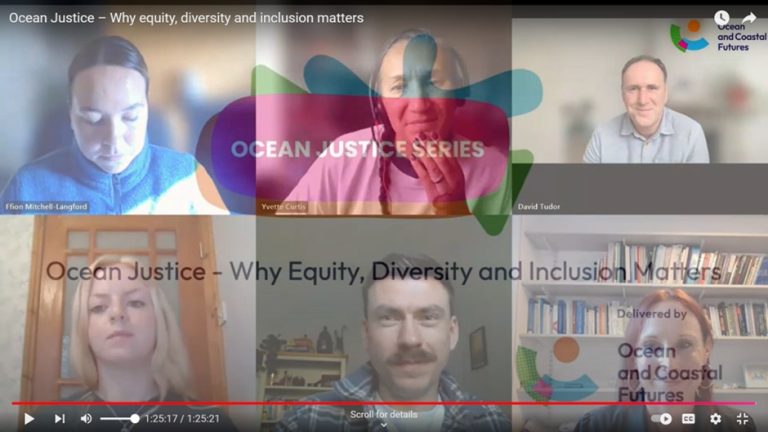
On 14 November 2024 ‘Ocean Justice and the Blue Economy’ principal investigator Dr Celine Germond-Duret took part in a webinar on “Ocean Justice – Why Equity, Diversity and Inclusion Matters”. This event is the first panel of discussion of Ocean and Coastal Futures (OCF)’s Ocean Justice Series. This blogpost summarises key messages highlighted by panellists.

The panel was chaired by the Director of OCF, Dr David Tudor. It brought together leading ocean experts including:

Alan Munro – Founder and Director of Young Sea Changers Scotland

Yvette Curtis – EDI Manager at Surfers Against Sewage and Founder of Wave Whine’s

Ffion Mitchell-Langford – Project Designer & Manager of the Marine Conservation Society’s Hiraeth Yn Y Mór (HYYM) Project, EDI Co-Chair at the North Wales Wildlife Trust, Founder of Future Generation Consultancy and National Marine Parks Lead at Campaign for National Parks

Caitlin Turner – Young marine biologist undertaking an MSc in Marine Vertebrate Ecology & Conservation and a Trustee for Young Sea Changers Scotland.

Celine Germond-Duret – Project investigator of the ‘Sea Sights’ project investigating young people’s connection to the coastal and marine environment; and of the Leverhulme Trust project ‘Ocean Justice and the Blue Economy’; Lecturer at Lancaster University.

The panel centred on two questions:

  • Why we need a more diverse and inclusive marine and coastal sector?
  • Why we need to transfer more power to young people/communities in marine decision-making?

Why we need a more diverse and inclusive marine and coastal sector?

  • Caitlin Turner noted that any issues that affected the ocean will have impacts on everyone. However, the burden is not shared equally across different ocean stakeholders. People with disabilities and minorities are disproportionately affected by environmental issues related to the ocean. These groups’ voices, however, are often not being considered. Caitlin calls for the needs of all ocean stakeholders to be met and their voices to be included in governance processes.
  • Celine Germond-Duret stressed that diversity and inclusivity in marine and coastal sector is something that needs to be done both for ethical and efficiency considerations. Reflecting on development on land, we witnessed conflict and harms being done to Indigenous Peoples due to the lack of inclusivity in designing and conducting conservation and development projects. Such projects also tend to be ineffective in terms of their implementation because of their failures in taking into account local communities’ views, identities, and knowledge.
  • Yvette Curtis drew attention to the fact that the majority of UK marine protected areas (MPAs) are based at the country’s overseas territories. Against this background, Yvette underscored the importance for the UK government to seek inputs from island governments and coastal communities on how to protect these areas. Only by getting the perspectives of these stakeholders the UK government can make critical decisions.
  • Ffion Mitchell-Langford pointed out that diversity and inclusivity in marine and coastal sector is crucial because everyone is responsible to protect the ocean and is steward of the ocean. Capacity strengthening through ocean literacy and locally managed MPAs provide avenues for local stakeholders to be included in conservation and sustainable use of marine resources.

 Why we need to transfer more power to young people/communities in marine decision-making?

  • According to Alan Munro inclusion of young people in ocean governance is critical because young people have ‘out of the box thinking’ that helps to bring new solutions that the sector crucially need. Young people are also the group who will live with the consequences of any decision taken related to ocean and coastal governance. Governments, therefore, will need to work with young people to find solutions that work for everybody.
  • Celine Germond-Duret, Yvette Curtis, Caitlin Turner, and Ffion Mitchell-Langford identified various barriers that need to be addressed to make ocean-decision making process more accessible to young people. Celine identified two important barriers including first, a certain dominant framing of the ocean (e.g. an inhospitable space, not a place of identities and connection). Second, the question of access (e.g. how young people can access blue space). Drawing from her research, Celine illustrated that although some children live less than five miles from the ocean there are difficulties for them to access blue space because of financial costs or social and cultural elements. For example, Celine explained that some children view that coast and sea are not for them because of certain ‘picture’ that they portrayed in their mind when they think of the sea (e.g. the image of white middle-class families walking their dog on the beach). Yvette echoed this point, as she noted that cultural connections, access to blue space, and the continuous portrayal of ocean as elite areas could hinder the inclusion of young people in ocean advocacy. Ffion further mentioned that language and visual representation of ocean and coasts are key barriers for inclusion. To improve inclusion, Ffion suggest making key information and documents relevant to ocean management available not only in English, but also in other languages spoken in the UK (e.g. Welsh). Caitlin emphasised the importance of using language that are accessible to young people and avoid complex policy language with jargons.

Conclusion

Our panellists concluded the event by sharing their insights on how to value, recognise and strengthen efforts to transfer power to young people. Their suggestions are listed below.

  • Working with organisations at grassroot level (e.g. school, community centres) to reach out to young people and find local solutions.
  • Not putting young people in one category as they may come from diverse social-economy and cultural backgrounds.
  • Making young people feel valued, recognising and celebrating their contributions.
  • Involving young people in co-designing research and other activities; maintaining contacts; and being transparent related to outputs generated from the research or other activities.
  • Sharing data that will support the development of the capacity, findability, interoperability, and re-usability of ocean data, information and knowledge.
  • Prioritising bottom-up approach.
  • Valuing different types of sciences including social sciences and knowledge systems including traditional knowledge and their knowledge holders.

The webinar recording is available on the Coastal Futures Youtube channel.