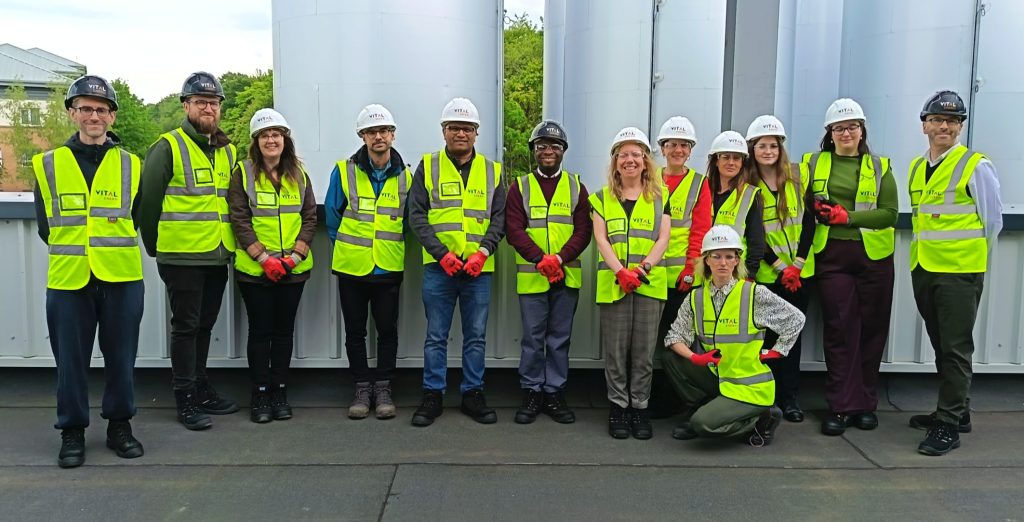
Participants of the Project Launch at Lancaster University’s Net Zero Facility
On the 8th May 2026, we hosted at Lancaster University a hybrid launch event for our three-year research project funded by the National Institute of Health and Care Research (NIHR) Health Service Delivery Research Stream: ‘Assessing the Impact of Virtual Wards on Decarbonising Acute Care: A Mixed Methods Study’
The NHS has committed by law to stop adding to climate change by 2040, and is the first health care system in the world to make such a commitment. Acute care is currently the largest contributor of carbon emissions in clinical care, and so we need to understand if there are alternative methods of care that can be better for the environment, whilst still providing good care to patients and their carers and families.
Virtual wards (NHS England » Virtual wards) are an alternative to acute hospital care. They provide an acute clinical service to people in their usual place of residence, including care homes, with staff, equipment, technologies, medication and skills usually only available in hospitals.
The launch was a good opportunity to get to know each other a bit more as a team, gain feedback and insights to refine the research whilst we are still developing data collection material. Virtual wards have the potential to reduce NHS direct emissions from the delivery of care and indirect carbon emissions from patient and visitor travel. The potential impact of virtual wards on reducing direct carbon emissions stem from reducing hospital occupancy including lighting, heating, ventilation, air conditioning, staff travel, food, equipment use and laundry.
VWard will:
· Describe the activities used to care for people with these health conditions when they are in hospital and when on a virtual ward.
· Use this information to help us think about how to design the best care for everyone
·Ask patients and carers what they know about the environmental impact of health care
·Ask how we can we help patients and carers to think about how the environment is affected when they are choosing their care options
· Speak with health and care staff to understand how much they know or think about the environmental impact of acute care and if they have the digital skills needed to provide care in virtual wards.
· Estimate and compare the carbon footprint of virtual wards to that of hospital stays
· Compare the environmental, health, and economic effects and benefits of virtual wards to that of hospital in-patient stay
How will we do it?
We will use workshops, surveys and interviews with patients, carers and staff to understand:
1) what people know and feel about the carbon emissions of medical care for acute conditions
2) what sort of messages the NHS should use to get people to think about the environmental impact of medical care when making decisions about their treatment plans.
3) asked patients and carers to fill out a survey on their energy usage
4) speak with health and care staff working on virtual wards to identify all the activities that are involved.
5) Ask the staff to fill out a survey on how much they know about how the care they deliver contributes to carbon emissions
6) Ask staff about their confidence with using digital technology.
7) Find out what training staff may need to deliver virtual wards to reduce the carbon footprint of the NHS.
8) Use data on energy usage for hospitals, patients, staff working outside the NHS to estimate carbon emissions of virtual wards and compare this to hospital care.
9) Compare virtual wards and hospital care for costs, health outcomes, health service usage and carbon for the NHS and patients/carers.
The presentations and discussions were followed by a quick lunch break (where we had some super tasty vegetarian sandwiches and bites, thank you Lancaster University catering team!) and were able to have some more informal conversations.
After our lunch, we were then joined by the Project Manager from Lancaster University’s Net Zero Project (Net Zero Energy Project – Lancaster University). They explained how the University is taking steps to reduce it’s carbon emissions, through the use of solar panels, wind turbines and new heat pump technologies with the aim of reaching net zero on emissions. Their aim is to move towards using electricity only as a power source. This was incredibly helpful to have someone explain how an organisation sets about trying to reduce carbon emissions, the cost of it, and the amount of work involved in doing so.
This talk was the warm-up. Hard hats, safety boots, high visibility vests and a safety talk later and we found our group stood in amongst the building works of Lancaster University’s new energy centre. As we were guided round by the site manager and colleagues, it was incredible to witness the engineering that has gone in to find a solution to electrify energy use for sustainable power at scale for a university.
The enormity of the scale of the challenge was laid bare by seeing what was needed for a single university campus. The facts around the cost, resources and planning needed to undertake a project on this size for long term carbon emissions reductions was tremendous. However, what was even greater was the people behind the build who were creating solutions to achieve their goal. They explained that something of this size hadn’t been done before, so they made the equipment and materials to do it. They didn’t change the goal posts, they didn’t say it couldn’t be done. They found a solution, developed it, and produced it.
I was inspired. There is a way we can look to reduce our carbon footprint and reduce the carbon emissions of the NHS. We need to explore creative solutions. We need to work in partnership to develop ideas into projects. Then we need to produce and implement it.
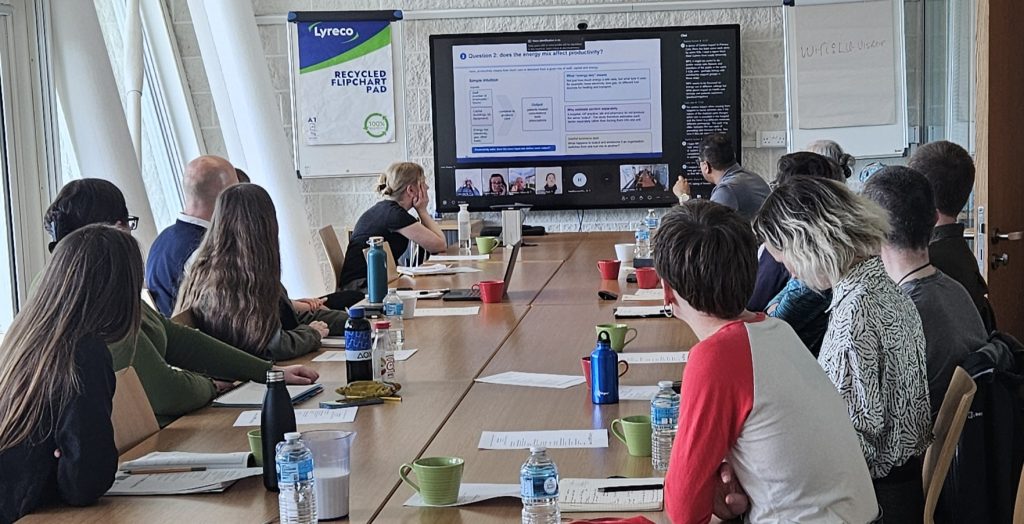
Project launch in session
This project that I am lucky enough to be a part of, is starting to try and explore options for reducing carbon emissions in the NHS. Specifically, I’m working to explore patient and carer perspectives on carbon emissions, acute care and virtual wards. This is just one of five similar projects funded to do this. There are also lots of other similar projects happening across the NHS at local, regional and national levels looking at ways to reduce carbon emissions of care. The ambition is there. The appetite is there. There is a collective swell of interest in making this happen. If we can find the solutions, which may include scaling up projects such as that in place at Lancaster University, and looking at how we can implement safe, but carbon reducing care, then the NHS will be well on it’s way to meeting it’s goals.
Thank you for reading and if you have any questions please do get in touch with us!
v-wardstudy@lancaster.ac.uk
Bethany Gill
(Senior Research Associate at Lancaster University, and Co-Lead for Work Package 2 – exploring patient and community perspectives on virtual wards and carbon emissions)
