
Have you been involved in choosing a care home for you or someone you are close to? If so, did you look at the care home websites? Why or why not?
What does ‘care’ mean to you?
We live in a society that tends to regard care as a resource that is ‘provided’, either for “free”[1] or by being directly ‘bought and sold as a commodity’ (Dowling, 2021, p. 29). In this blog post, we focus on care homes, which are institutions that provide accommodation, food, activities, and varying levels of personal care in exchange for money. This sector has become increasingly commercialised over recent decades and now, approximately 87% of care homes are run by for-profit companies, with 10% run by charities and 3% by local authorities or the NHS (carehome.co.uk, March 2026). This shift is important because for-profit care tends to be associated with more instability, lower quality care and worse working conditions for staff (including less training, a higher staff turnover and lower pay (Blakeley and Quilter-Pinner, 2019; Corlet Walker et al., 2022; Dowling, 2021).
Question: What is the average cost of a care home in England in 2026?
A. £500 to £850 per week
B. £900 to £1,600 per week
C. £1,000 to £1,800 per week
Answer at the end of the blog post.
In this blog post, we consider the websites of the two largest UK for-profit care home chain providers: HC-One and Barchester Healthcare. Both run over 200 care homes that offer residential, dementia and nursing care. Both are owned by investment firms and overall,have Care Quality Commission evaluations that are comparable to the national average. Yet, both have also been in the news for operating homes that provide inadequate care (e.g., understaffing, inadequate training and poor safety; Gordon-Farleigh and Briant, 2023; Shepka, 2023) and there was even a BBC Panorama investigation of the financial structure of HC-One (Melley and Holt, 2021).
We’re interested in exploring how these two companies represent their care homes, the people living/working in them and potential customers on their websites, alongside asking the related question: what is ‘care’ shown to be? Our analysis is based on the websites in February 2024 and if you’d like to read a more detailed discussion of this topic, you can read our chapter here.
The openings of the two websites are shown below for comparison:
![Image shows the opening homepage of HC-One. The slogan is 'The kind care company' and the heading is 'A cosy and caring home this winter'. The text reads: 'This winter, we are here to welcome you with the kindest possible care, whether it be a little care break or a longer stay. Our family of high quality residential, dementia and nursing care homes across England, Scotland and Wales provide a place where the people who care for you really care about you. To find out how we can help you live better each moment of every day, speak to our friendly care advisors on [number].'](https://wp.lancs.ac.uk/public-discourses-of-dementia/files/2026/09/image.png)
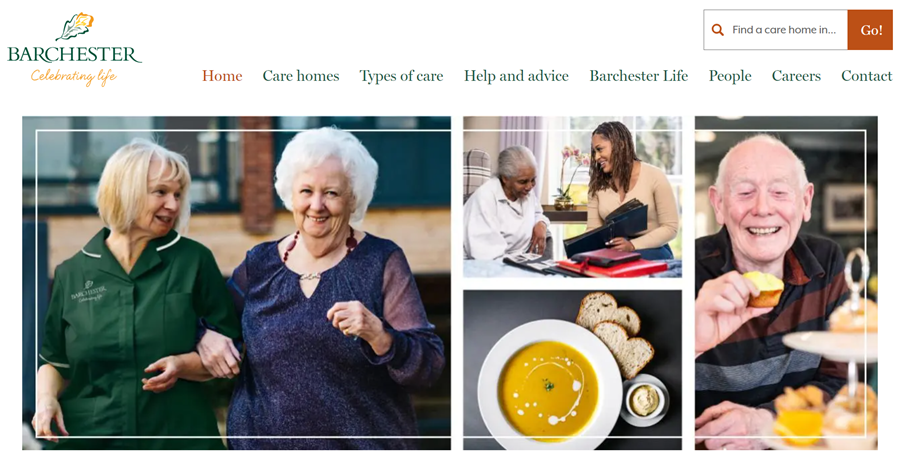
Overall, we found that the companies branded their care homes very differently. HC-One draws on idealised ideas of ‘family’ and the ‘family home as the optimum care location’, which, interestingly (and perhaps of no surprise to readers) is ‘the linguistic and ideational root of the term “care home”’ (Daly, 2023, p. 797). In contrast, Barchester reimagines the institutional care home as a desirable destination for people looking to enjoy older age, much like a luxury hotel. In many ways, modern care homes are like hotels – customers pay for their own room alongside access to communal spaces, catering and activities that are run by a company – and paying more will usually get a better service. This difference is exemplified by their catering pages, with HC-One calling it ‘the heart of the home’ while Barchester speaks of its ‘hospitality services’.
But whether branded more as a “home” or “hotel”, both companies seek to persuade potential clients that their product of institutional care is worth buying. They both associate good care with person-centred care (which is legally required in the UK) and focus on relationships between staff and residents, while backgrounding the business side. When the financial aspect is mentioned, it may even be reframed as being for the customer’s benefit rather than the company’s. For example, in the booklet, Paying to Live in a Care Home, Barchester state that ‘We will discuss with you the financial aspects and we will ask you to provide evidence of two years’ funding so that you can feel comfortable on this point’ (my emphasis).
Concerningly, although the two websites emphasise that they value and support residents’ individual identities and preferences, the (prospective) residents are noticeably absent in these websites, both as speakers and as addressees. Residents are often discussed in the third person – for example, Barchester writes: ‘Imagine a little peace of mind… with the reassurance that your loved one is surrounded by caring people who value them for the unique person that they are’ (my emphasis). Although the involvement of the person (wherever possible) is central to person-centred care, at multiple points on the websites, prospective residents are ignored and other people are addressed, which implicitly removes prospective residents from the conversation about their own future. Given that marketing materials tend to present an idealised picture, this exclusion is especially concerning.
Meanwhile, staff at these care homes risk being seen as instruments that deliver person-centred care rather than as dignified persons in their own right. They are often incorporated within the broader ‘we’ of the company and if they are described, they are idealised as ‘caring, warm-hearted and jolly people who have an affectionate understanding of our Residents and their individual needs’ (HC-One). Of course, these websites are aiming to advertise the care home providers but taken more broadly, it is important to recognise that such representations can be detrimental to staff wellbeing and normalise exploitative working conditions, such as regularly providing unpaid labour, forcing emotional performances (e.g., smiling regardless) and not challenging the low pay that is rife in the sector (Johnson, 2015, pp. 118–9).
Looking at care provider websites, then, offers a useful insight into how companies choose to present their care homes, staff, residents and the very notion of ‘care’. Communicative choices can reflect but also influence how care is understood and carried out, making them important to look at as part of better understanding, questioning and improving current practices surrounding ‘care’.
What do you think is missing from these websites? What would you like to see?
[1] We use scare quotes around “free” since unpaid care is still costed – for instance, the economic contribution of unpaid carers in England and Wales has been estimated to be £162 billion annually (Petrillo and Bennett, 2023).
ANSWER: The answer is C. It costs £1,000 to £1,800 per week on average for a place in a care home in England in 2026.
Source: Care Home Guide UK (March 2026). Care Home Costs UK 2026 https://www.carehomeguide.uk/guides/care-home-costs
References
Blakeley, G. and Quilter-Pinner, H. (2019) Who Cares? The Financialisation of Adult Social Care. London: Institute for Public Policy Research.
carehome.co.uk (March 2026). Caring Britain: how the care home landscape is changing. https://www.carehome.co.uk/wp-content/uploads/sites/2/2026/03/Caring-Britain-How-the-care-home-landscape-is-changing-report.pdf
Care Home Guide UK (March 2026). Care Home Costs UK 2026 https://www.carehomeguide.uk/guides/care-home-costs
Corlet Walker, C. et al. (2022) Held to ransom: What happens when investment firms take over UK care homes. 35. Guildford: Centre for the Understanding of Sustainable Prosperity. https://cusp.ac.uk/wp-content/uploads/UNISON-CUSP-report-final.pdf.
Daly, M. (2023) ‘Care Workers in English Care Homes: Managing Commodification, Motivations, and Caring Ideals’, Social Politics: International Studies in Gender, State & Society, 30(3), pp. 795 817. https://doi.org/10.1093/sp/jxad012.
Dowling, E. (2021) The Care Crisis: What Caused It and How Can We End It? London: Verso.
Gordon-Farleigh, N. and Briant, N. (2023) ‘Northampton: Care home rated inadequate by inspectors over training’, BBC News. https://www.bbc.co.uk/news/uk-england-northamptonshire 65756483.
Johnson, E.K. (2015) ‘The business of care: the moral labour of care workers’, Sociology of Health & Illness, 37(1), pp. 112–126. https://doi.org/10.1111/1467-9566.12184.
Melley, J. and Holt, A. (2021) ‘Care homes: Following the money trail’, BBC News. https://www.bbc.co.uk/news/uk-59504521.
Petrillo, M. and Bennett, M. (2023) Valuing Carers 2021: England and Wales. London: Carers UK. https://www.carersuk.org/media/2d5le03c/valuing-carers-report.pdf.
Shepka, P. (2023) ‘The Elms: Whittlesey care home’s chaotic final days’, BBC News. https://www.bbc.co.uk/news/uk-england-cambridgeshire-64939698.