
We are excited to announce that our project is entering a new phase! With the support of a UKRI Future Leaders Fellows Renewal Grant, we will build on our previous and ongoing work investigating how dementia and people living with dementia are represented in the public sphere and how this might relate to dementia stigma. Our focus is moving beyond identifying problematic representations to address a related question: what does good communication about dementia actually look like?
What do we mean when we say…
‘Public Discourses of Dementia’ – here, we’re looking at how dementia and people living with dementia are represented in the public sphere. We’re especially interested in the language and images used in a range of contexts (e.g., in the news, public health campaigns and on social media) and in what these representations do or don’t focus on.
‘Dementia stigma’ – Broadly, this refers to the negative stereotypes and attitudes that are associated with dementia, which can in turn contribute to the unfair treatment of people living with dementia. Dementia stigma is complex and can be discussed in relation to the general public, internalised (self) stigma, social structures (such as healthcare or the legal system) and stigma by association (e.g., family members may also experience stigma).
As we know, the ways we communicate about dementia matter. The words and images that are used in contexts like the news and awareness-raising campaigns – and, increasingly, by generative artificial intelligence (AI) – shape public understanding of dementia. This means that they influence how people living with dementia are perceived by others, how they see themselves and even whether people feel able to seek support or a diagnosis.
Over the past few years, our research has demonstrated how language and visual imagery can reinforce negative stereotypes about dementia. A key challenge remains, however. While public discourse frequently talks about people living with dementia, it rarely reflects their own experiences or perspectives. As a result, there is relatively little evidence about how lived experiences can be represented authentically and constructively in public communication.
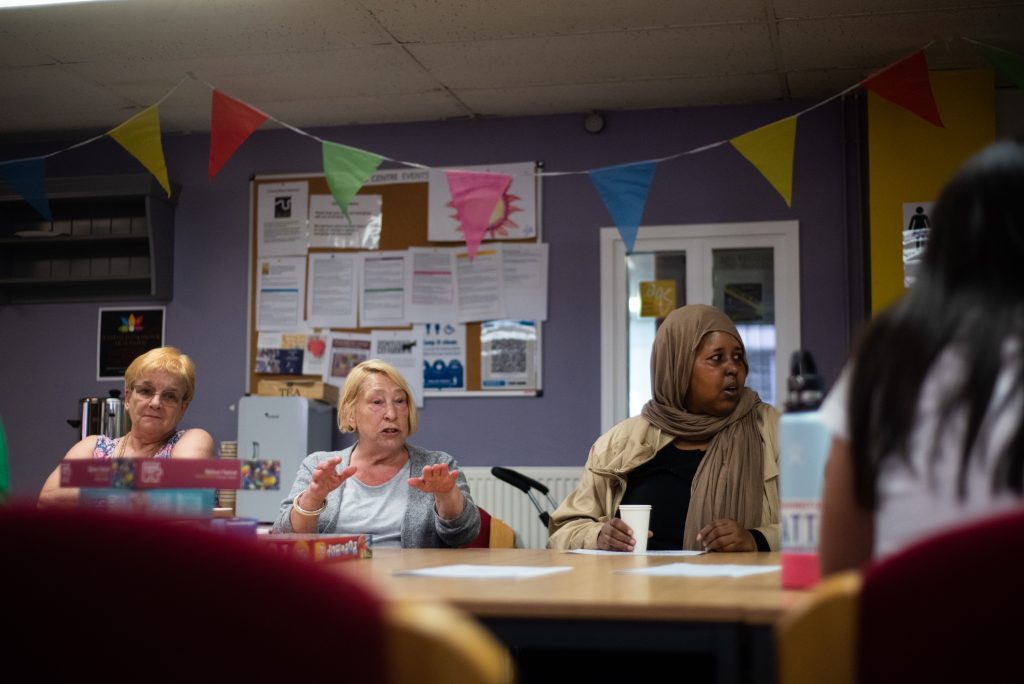
The next phase of our work seeks to address that gap by placing the voices of people with dementia at the centre of our research. Rather than us, as researchers, deciding alone what counts as respectful or effective communication, we will work directly with people living with dementia, family members, carers and communication specialists. Through a series of focus groups run in collaboration with Dr Felicity Slocombe (Department of Applied Dementia Studies, University of Bradford), participants will discuss examples of real texts and images, helping us to understand which representations resonate with their lived experiences and, just as importantly, which ones fall short. These conversations will shape every stage of the work. For example, participants’ contributions will help us refine our analyses, identify more constructive ways of communicating and develop practical guidance that reflects the experiences of those most directly affected.
Ultimately, this work aims to produce practical benefits beyond academia. Specifically, the findings will be used to develop evidence-based communication guidelines for journalists, charity professionals and others responsible for communicating about dementia. Rather than focusing solely on language to avoid, these guidelines will offer positive examples of how lived experiences can be represented more authentically and respectfully.
Alongside its societal impact, the work will also aim to make an important methodological contribution. The corpus linguistic methods we continue to use in our work are exceptionally good at identifying patterns across large numbers of texts, but these, by themselves, cannot tell us how those texts are interpreted by different audiences or what factors may have influenced how the texts are produced. Therefore, by combining large-scale corpus analysis with focus groups, we aim to develop an innovative research approach that brings together quantitative evidence with the perspectives afforded by lived experience. We are hopeful that this framework will have the potential to benefit not only future research on dementia-related communication, but also other areas of socially engaged language research.
We are excited to begin this next, more collaborative phase of the Public Discourses of Dementia project. If you’re interested in getting involved or if you have any other questions or thoughts, please get in touch!