
When you first start reading about gender, arguably one of the most confusing concepts to grapple with is how the terms ‘masculinity’ and ‘femininity’, which may once have seemed overarching and definitive, are often discussed as plural ‘masculinities’ and ‘femininities’. These plural terms, whilst ubiquitous in academia, don’t seem to crop up too often in broader public conversations about gender.
Before I answer the question posed in the title, I should point out that the explanation builds on the idea of gender as a socially constructed performance, which is explored in Johnny’s Basics post on gender. It also relies on the fundamental distinction between gender identity and gender expression, which the American Psychological Association (2023) clarifies as follows:
“Gender identity refers to a person’s internal sense of being male, female or something else; gender expression refers to the way a person communicates gender identity to others through behavior, clothing, hairstyles, voice or body characteristics.”
Once we understand gender in this way, it becomes easier to see that there are countless ways of expressing masculinity and femininity through appearance, language, paralinguistic features, and more. When we make the jump from masculinity to masculinities, for example, we can talk about masculinity within female characters without implying that they are men or boys (Onyx’s post on Revolutionary Girl Utena is a great example of this). We can also distinguish different gender expressions in different male characters, taking an intersectional approach to consider how different aspects of identity and experience can affect masculinity.
Masculinities in different male characters

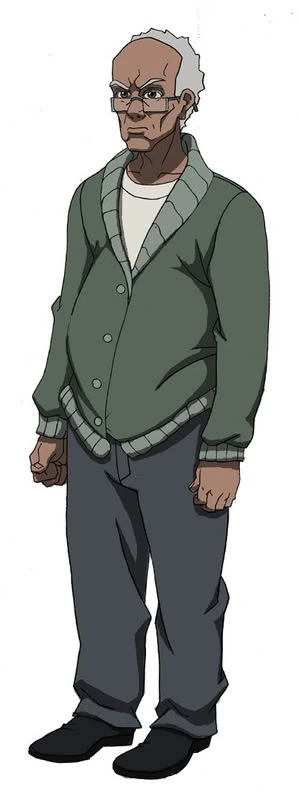
Take the two characters depicted here: Gaston (right) from Beauty and the Beast (Disney, 1991) and Robert Freeman (‘Granddad’, below) from The Boondocks (McGruder, 2005-2014).
Even if this is your first impression of either of these characters, it’s probably easy to visualise that they exhibit masculinity in different ways. Still, we probably wouldn’t call one more or less masculine or feminine than the other. Whilst Gaston is the muscle-adorned poster boy for traditional masculinity, factors such as race and age influence Robert and his expression in a completely different way, with his character remaining recognisably masculine.
We might call Gaston a textbook example of the specific and widely discussed subcategory of masculinity, white hegemonic masculinity, which Vicky discusses in more detail in her post on How to Train Your Dragon. In simple terms, this type of masculinity seeks to assert and maintain dominance over other groups, whether it be women or men who do not perform gender in the same way (Jewkes et al., 2015). The fact that Gaston can adopt this form of gender expression is made possible through his being a young, powerful, white man, and is consistent with his use of language. Throughout the film, he repeatedly produces possessive utterances and pronouns to convey the sense of ownership he feels over women, clear in such declarations as “I’ll have Belle for my wife” and “Belle is mine”. His character’s linguistic strategies ultimately serve to position him as authoritative, as illustrated once more in the prescriptive normative statement “It’s not right for a woman to read”, which morally condemns women for taking part in ordinary, genderless activities.
Conversely, Robert’s masculinity is impacted by his status as ‘Granddad’, and also his position as an older Black man living in a predominantly white suburb. Whilst this character does harbour some similarly unsavoury views on women, most of his authoritative language is reserved for commanding his two grandsons. Other linguistic features, such as frequent usage of the ‘N-word’ and grammatical structures influenced by African American Vernacular English (AAVE, sometimes called Ebonics) are just some which highlight contrasts between Robert and Gaston. However, this representation becomes yet more complex when we consider the partial code-switching present in the clip below. Here, Robert is introduced to neighbourhood patriarch Ed Wuncler and consequently begins using more polite and submissive forms of language.
These characters have shown a few areas which highlight the need to subdivide masculinity into multiple masculinities. It’s worth bearing in mind that the characters discussed in this post are ostensibly all cisgender and heterosexual, so I’d recommend checking out Onyx’s post on genderqueer identities, and Jasmin’s post on Hercules for an example of queerness affecting masculine expression.
Before moving on to discuss some female characters, I should also address the elephant in the room that… there are no elephants, or anything non-human for that matter, in these examples! This does not mean masculinities and femininities are only relevant for people, especially when dealing with animation. You only need to watch the clip below, with the imperative forms and masculine timbre of the Tramp in contrast with the relatively silent disposition of the Lady, to appreciate how this can be extended to non-human animals. Again, see Johnny’s post for examples of this with inanimate objects.
Femininities in different female characters
Femininity is often simply defined in terms of its differences from masculinity. This makes sense when we consider the heteronormative fixation on differences between men and women and the rigidity of the social gender binary – making masculinity and femininity completely at odds may make them as concepts easier to grasp. Femininity can sometimes therefore be ‘othered’ in academic analysis in favour of focusing on masculine expression, despite being just as rich and fluid in its variation (Schippers, 2007).

Betty Boop as she appears in the short film Betty Boop’s Life Guard (Fleischer, 1934) offers a fairly stereotypical way of representing femininity on screen. She is depicted using sexualised imagery featuring big eyes, an hourglass figure, and makeup and accessories that don’t seem practical for her swimming-based plans. Her language use in the film again paints a similar picture, with high-pitched giggling making up much of her linguistic content. This traditional idea of femininity is reinforced by repeated pleas of “help me” and “save me”, exemplifying the damsel-in-distress trope in such an obvious way it may almost seem self-satirising to a modern audience.

We can contrast this type of femininity with what is displayed by Linda Belcher in Bob’s Burgers (Bouchard, 2011-present). Although she is much less sexually suggestive in her appearance and is even voiced by a male actor, we can still confidently call Linda a feminine woman. Much of her gender expression is intertwined with her adherence to feminine social roles like mother and wife, which could be as simple as the use of kinship nomenclature by Linda herself and other characters to refer to her as ‘mom’ or ‘mommy’. She also frequently employs diminutive terms and uses pet names such as ‘Bobby’ and ‘honey’ to refer to her husband or children. Sometimes these more traditional aspects of femininity are contrasted with other aspects of her character to create comic effect, such as in the contextually questionable statements “Mommy doesn’t get drunk. She just has fun.”
Why is this important?
So, there’s more than one masculinity and more than one femininity, but why does realising this even matter anyway? One benefit of being able to recognise and apply this concept is broadening the scope for analysis, making any commentary more precise and, crucially, more interesting! I’ve included the diagram below to show how we could focus in on the social roles discussed regarding Linda Belcher in this way, but we could also focus in on different aspects of her gender expression.

On a broader level, with the rise of manosphere figureheads like Andrew Tate influencing young men and boys by claiming to possess the secrets of the singular correct way to be a man, it seems more important than ever to make clear the limitations of this viewpoint. With such diverse and conflicting versions of masculinity present amongst men and male-coded characters, using exultations like ‘be a man!’ as shorthand for encouraging more specific traits is imprecise and illogical. In fact, one of the manosphere’s own slogans seems to call into question the very core of their toxic ideology: “#NotAllMen”, which by its nature implies that there are different ways of being masculine. I would welcome this interpretation, and add to it #NotAllWomen and #NotAllNonBinaryPeople: everyone expresses and interacts with gender in their own unique way.
References
American Psychological Association. (2023, March 9). Understanding Transgender People, Gender Identity and Gender Expression. American Psychological Association. https://www.apa.org/topics/lgbtq/transgender-people-gender-identity-gender-expression
Jewkes, R., Morrell, R., Hearn, J., Lundqvist, E., Blackbeard, D., Lindegger, G., Quayle, M., Sikweyiya, Y., & Gottzén, L. (2015). Hegemonic masculinity: Combining theory and practice in gender interventions. Culture, Health & Sexuality,17(2), 112–127. https://doi.org/10.1080/13691058.2015.1085094
Schippers, M. (2007). Recovering the feminine other: Masculinity, femininity, and gender hegemony. Theory and Society, 36(1), 85–102.