About Me

My name is Amy and I’m a third year Philosophy (BA hons) student here at Lancaster. Hopefully these blog posts will allow you to get a feel of what life is like for typical student at the university. I will be keeping you up to date with how my course is progressing this year and with what I’ve generally been getting up to as a student.

It may only be week 4 of this term, but the work is already on a steady increase. That’s what comes with attending a ‘Top 10’ university I suppose! As I am a Single Honours student, my days are filled with philosophy modules. This term I am taking; Continental Philosophy, Darwinism and Philosophy, Philosophy and Popular Music, and Feminist Philosophy. Two of these are standard modules and two are special subjects; which I’ll explain later!

Right now in Continental Philosophy we are studying Nietzsche and his ideas about morality; where it came from and why what is ‘moral’ changes so much, the use of punishment, and the emergence of guilt and the conscience. His work is very different to the usual analytical-style readings that I have gotten used to over the past couple of years, and while it can be difficult to understand at times, I’m enjoying the challenge and it is quite a refreshing change. His work is going to be the subject of my essay at the end of this term.

As for Darwinism, we are currently understanding the theory of evolution and looking at some key thinkers surrounding the topic. For example; Dawkins and the ‘Selfish Gene’. Along with genetics we are questioning how important environmental factors are in evolution, as well as questioning whether the claim that the traits that we possess now ‘must be a product of evolution’, and so ‘must have a meaning for being there’. Right now we are just laying the groundwork for further philosophical discussion in the coming weeks- more of that to follow!

As for the special subjects, these are basically 2 hour seminars, once a week, and they are student-led. This means that, while there is a lecturer present to help and guide the discussion, it is basically down to us to start up conversation and encourage debate. Generally, the way this is done is by allocating each student (or group of students) one of the weekly readings of their choice. Then we have to create our own presentation and a handout of what we have read in which we; summarise and explain the reading, extract the key features of the arguments from the author, and identify questions that will lead to further discussion among the group. Don’t worry though, these are not assessed- but they really help with communication skills, and we can use the material that we come up with in our essays due next term, which is great!

Philosophy and Popular Music is the first of the  special subjects that I am taking, and by far the most different module to everything that I have studied during my time here. As of now, we are looking at the evaluation and aesthetic values of popular music with questions such as; ‘Is popular music standardised?’ ‘What implications does standardisation have on the value of popular music?’ In my second special subject; Feminist Philosophy, we are currently focusing on the work of Beauvoir in relation to the origins and solution to the oppression of women. For example; the idea that women are The Other, and the influence of biology in gender politics. Each of these have a 5000 word essay due for the first day back after Christmas.

Alongside all of this, I have been working on readings in preparation for my dissertation, but I have also managed to keep up with activities outside of studying. This past weekend I attended a 4 hour self-defence class with Just Play- a group that organises sporting events and taster sessions for anyone with (usually) any ability! It was a great session that I got to experience with one of my close friends, the session leaders were really supportive, and we both actually learned a lot! It was also Halloween this past weekend, so the community spirit within the university was at an all time high- definitely one of the most fun holidays to celebrate here in Lancaster!
Introductions…

Allow me to start by introducing myself. My name is Ryan, I am a third year BA (hons) student of Politics and Philosophy at Lancaster University. I am also the captain of my college pool team. My blogs, which will be published weekly, will hopefully give some insight into life as a Lancaster student. As well as being a great place to study, Lancaster offers a wide range of social activities. So rather than focus strictly on academic life, I will try to strike a balance between the two.

Although I am only three weeks into the new academic year, it feels like so much has already happened. In week one, I had to select my new pool team. As most of last year’s team have graduated, this was a more difficult task than I’d anticipated. But luckily for me, we had an influx of first years adept with a cue. Last week we had our first league match. Playing your first match in front of a crowd of people can be nerve-racking, but everyone held strong, and we ended our first match with a 6-3 victory. Being part of a sports team has been an amazing experience, and Lancaster has a lot to offer for those considering joining one. Each college has their own sports teams, which host tasters and trials across Fresher’s Week and into Week 1. As well as this, there is the annual “War of the Roses” competition with our friendly rival York University.

The bulk of my time so far has been taking up with studying and dissertation preparation. The philosophy modules I am taking this term include Moral Philosophy and The Philosophy of Medicine. I am finding both of them really interesting, albeit challenging. For moral philosophy, we are reading a book called Reasons and Persons, by Derek Partit. In this book, Parfit challenges the established orthodoxy on subjects ranging from rationality, personal identity and morality. He seeks to answer some of the most important questions of philosophy, such as: what do we have most reason to do? and what obligations do we have to future people? I am only a few chapters in, but as I progress I will discuss some of Parfit’s views in my later blog posts.

In The Philosophy of Medicine, we discuss concepts of health and disease. Most of us take concepts such as “health” and “disease” for granted, but closer inquiry leads to some difficulties. For example, is there a difference between an illness and a disease? And is health an internal physical state or is it dependent on something external such as a person’s environment? These are all interesting questions and I look forward to developing my answers when it comes to writing the essay.

As much as I enjoy my subjects, I am looking forward to having a break at the weekend. On Saturday, I am meeting up with my pool teammates for some practice in our college bar. On Sunday, I have family coming to visit, which means – as my family includes my dog Flynn – that I will have to find a dog friendly pub in town, as a pub meal is standard when my family visit. Last time I took them to The Three Mariners, which is situated near the Castle. Good food and real ale, it doesn’t get much better than that.

Final Term Project – Part 2

Animal Care Project

Following on from my last post, about the final project in design, I will now look in more detail at our project and what our design proposal was.

We decided to use the animal shelter, Animal Care as our base for our ideas. This is the business we would link with the residents.

Slide 1

Initial Ideas

Initially we thought we should try and link Animal care, with schools and improve children’s wellbeing by taking animals to the schools and allowing the children to interact with the animals.

We wanted to talk to the shelter about what sorts of animals would be suitable for this. As well as if they would want people coming to the shelter or if the animals should go to the people.

We needed to look around the shelter and see what sort of scale it was as well as if it was suitable to have people come to the shelter.

Research:

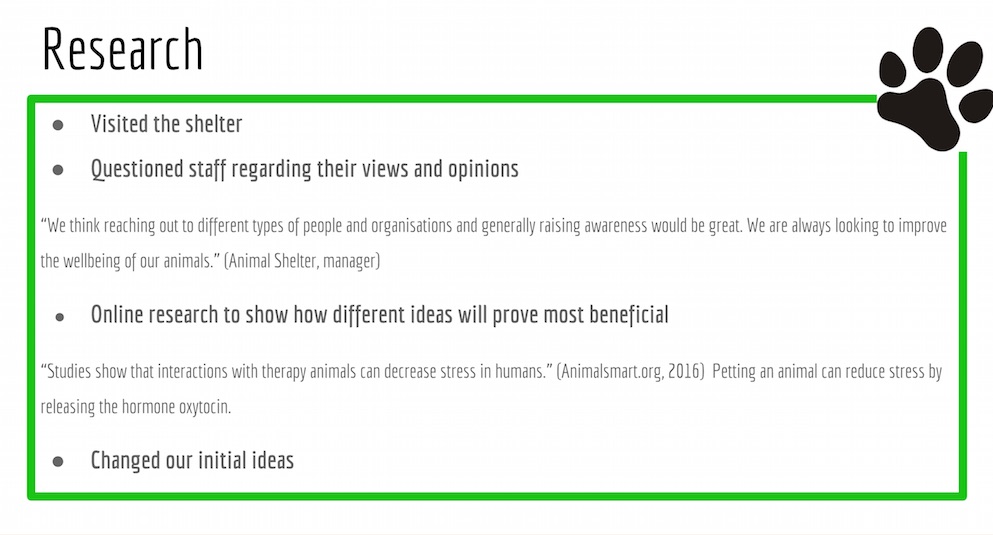
After doing our initial secondary research, we went to visit Animal care. It was much easier than we thought, as it is vey close to Lancaster City centre. This meant a quick bus ride for us.

We then looked at all the animals and the facilities the shelter had. We spoke to staff about our initial ideas.

It was so beneficial for us to do, as without us doing this we would have gone down the children and animals route. Which we discovered may not be the best idea.

This lead us to think about other ideas, and what sort of Lancashire residents wellbeing we could improve with the use of animals.

We talked with the head of the animals at the shelter, and Michael, a man who deals with the link between the shelter and the public.

He was a great source of information. By talking to him and thinking about our ideas we came up with the idea of Retirement homes and Universities as being a good way of linking animal care to Lancashire residents.

We found out the the shelter has stay in animals that can never be adopted, these animals are used to seeing people and are what the shelter use for sponsorship animals. Having both cats and dogs, we decided these would be perfect for the job of therapy animals.

Reserach Slide


We then talked to UCUM and the retirement homes to see if this would be something they would be interested in.

After getting their views we confirmed our ideas, and began to come up with scheme ideas, and plans.

Without doing this research we would not have ended up with the ideas we did, this showed us just how important it was, and that you can not assume ideas will work.

Design Schemes:

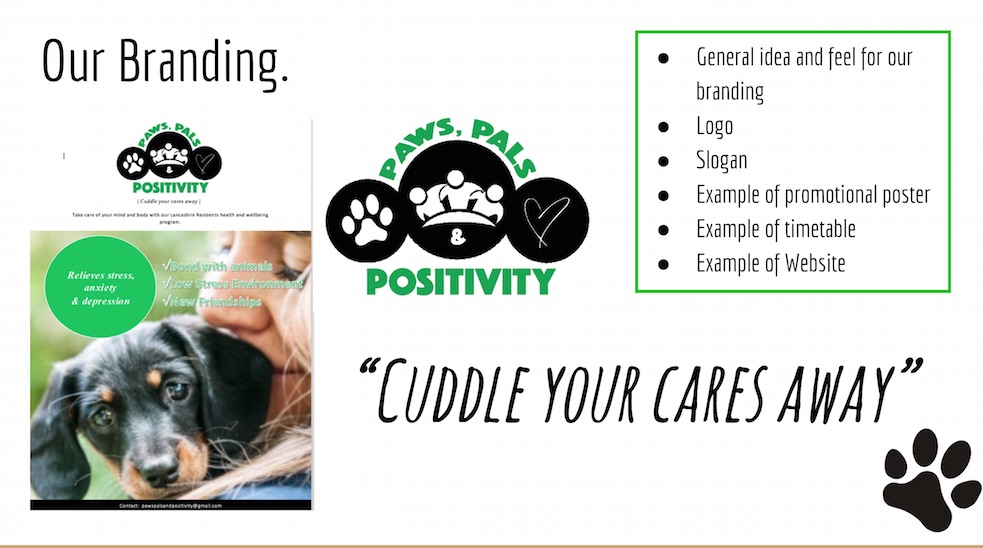
We wanted to brand our ideas, and have a sort of business that we could in theory show people and become the link between Animal Care and the university or retirement home.

This lead to ‘Paws, Pals and Positivity’ being created. Our brand, with the slogan ‘Cuddle Your Cares Away’. We felt this very simply showed what we were trying to do.

Our design proposal consisted of two Schemes, similar in design but changing small elements so that each was tailored to the business we wanted the to work with.

At this point we decided the work up more so each person knew what they were doing, it was amazing how much work we got done and how well we worked as a team. It was a really great experience, and showed that from a very basic idea we were able to come up with a well thought out idea.

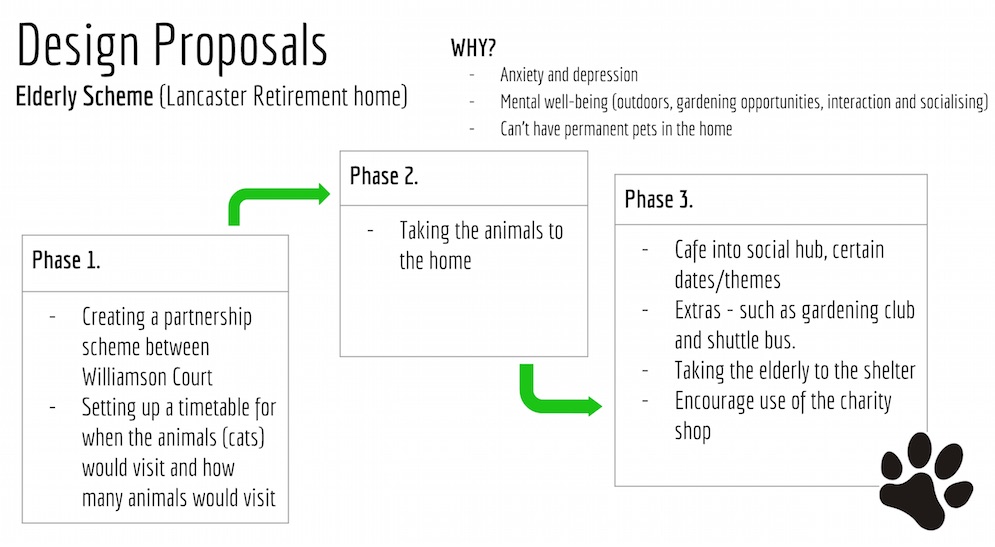
The basic idea was the the Retirement Home Scheme would involve the cats from Animal care going to the home and interacting with the residents. We slip the scheme into phases to allow us to clearly illustrate how our plan would work.

In terms of benefits, we worked it around mental wellbeing in the initial stages, then residents would be able to go to the shelter in phase three if they wished. Allowing physical wellbeing to be improved too.

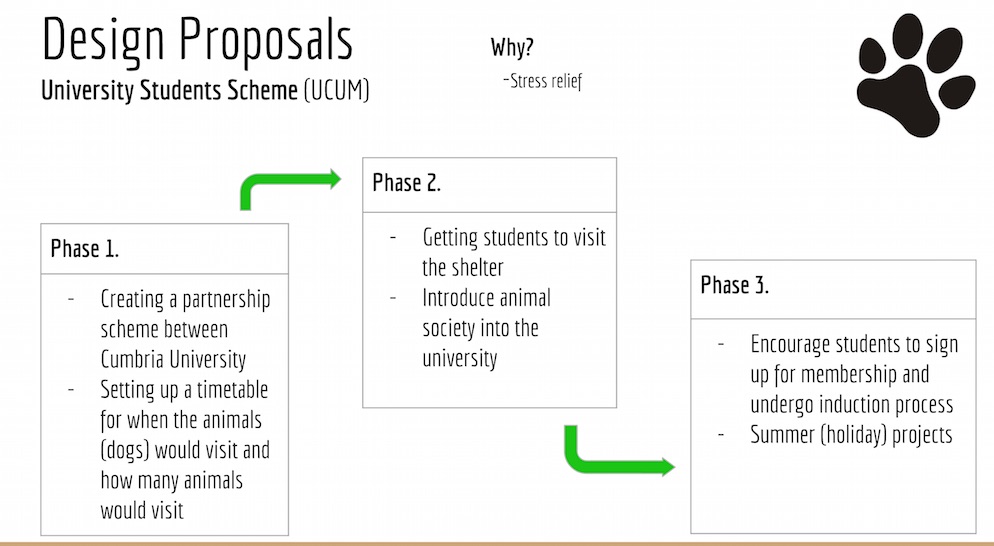
For our UCUM Scheme, we based this more around dogs, as the students and teachers would be younger and be able to be more active with the dogs. We wanted to use the dogs to reduce stress during exam periods and stressful times of the year, for both students and staff.

We gave a very detailed description of both of our schemes and the benefits to all parties including animal care in our 5000 word report. As well as in our presentation. The presentation slides for the schemes show how we broke the ideas down.

Scheme Slide Scheme slide 2

Advertising:

We then wanted to go a bit further in our project. As we had already completed the brief, but we thought by showing the kinds of branding we would use, and mock websites would show what we were thinking.  It was a way of showing the design and marketing skills we had learnt too.

Advertising

Reflection:

Upon reflection of our project, i felt we really learnt how to work as a group, and we did this very well. It for me, gave a really good idea of what i had to come over the next few years at Lancaster. I am very excited for this, as i really enjoyed doing this project. Looking at animal care and being able to come up with design ideas, and branding ideas was really enjoyable, it was challenging as the brief was quite open. However, this allowed us to run with the idea, and explore different ideas.

I think we have all learnt from this as well, as ironically making the mistake at the begging of the project helped us in the long run. It showed us what we should not do and what we therefore, needed to do. We most defiantly learnt from these mistakes, and I feel corrected them, which allowed us to produce a well rounded project.

It seems strange that the first year of design is over already.

However, this final project was i feel the best, it incorporated all the skills we had learnt, such as the ethnography methods we used in out last project, as well as the idea generation in the first few weeks of Design at Lancaster.

I greatly look forward to what Design has to offer over the next few years, and I am sure I will be pushed just like I have been this year.

Final Term Project

Final Design Project

Over the last term in First Year Design, we have been very busy doing our final project.

It takes up the whole last term, and in a sense is our exam as there is no written exam in design, just course work, so this in effect takes its place.

The Brief:

The project brief was set, in groups of 5 people, we were to look at a business or a service in Lancashire and come up with a design proposal that would increase the health and wellbeing of Lancashire residents.

It was a fairly open brief, allowing us to use all of the design skills we had learned over the year into one project and show what we could do.

The project had to consist of a 5000 word group report and a 15 minute presentation, with questions being asked at the end, meaning this was going to be a very in depth project which had to be clearly thought out in all stages, showing well done research and a design proposal that clearly showed how it would benefit Lancashire residents and their wellbeing.

Our Project Ideas:

For our project I joined with 4 other girls who I had come to know over the year. We sat down and began to discuss our options and what we each felt would be interesting to work on. There were sections of project ideas to give us a little bit of guidance that the whole workshop group had created together.

Initially we thought about the topic of transportation and cycling, and felt it was a good idea to link with health and wellbeing as there are physical health advantages to doing more exercise. We were thinking up design ideas such as the Boris Bike scheme in London. But upon reflection, we realised we were going about the project the wrong way.

The brief stated we must link it with a business or service.  We thought about bike shops and such, but nobody had a clear idea of what we would be setting out to do.

The other error we had made was coming up with the idea we wanted to propose without doing any research to back it up. We had narrowed our ideas to early on. Something we had learned not to do in the first few weeks of design.

Luckily we realised our mistakes and decided cycling was not what we wanted to do.

This lead to a mass brainstorm from all our team members. I thought this is more like what design should be about, everyone became more animated and interested in the project as a whole.

This lead to the agreement that we would look into animal therapy and animal shelters in Lancashire.

This time we did not narrow our ideas, everyone sat around the table doing secondary research into things such as the benefits animals have on people in the areas such as mental wellbeing. I also called up animal shelters around Lancaster and set up visits, this meant we could conduct some primary research to help us build up our design idea. Also by visiting the shelter before contacting services and business such as schools and care homes it would allow us to see if the project was feasible. Then we could work to link it with specific areas of the Lancashire residents.

To help give our selves some guidance when talking to the animal shelter staff, we thought up some initial ideas of what we thought may work. However, unlike the cycling idea we did not limit our selves to just one. We wanted to uses these basic ideas as a talking point with the staff. With the aim of hearing their views on them, which would therefore allow us to adapt and change these ideas into ones that would work.

I think this clearly  shows the importance of idea generation when doing a large project like this. As if we had not really sat down and thought about what our ideas were and how we would execute them, we could have ended up with a project that was not completed to our full capability and having a piece of work that did not correctly fit the brief.

Design Ethnography Research Project

In my last post I wrote about Ethnography research methods, It can be found here, I am now looking at term two of Design. We were set a Design Ethnography project, this was our second piece of course work that would consist of a group presentation and an individual report. It was the first time we would be working in close nit groups for the duration of the term.

We were required to study a business or service in Lancaster city, and to conduct ethnography research for it, using methods which would help us to look at how a range of users experienced  our chosen business.

My group and I chose the category of Night Life, this allowed us to pick from a range of services from pubs to clubs. We decided on a Bar called Dalton Rooms, which is in the centre of the city.  It is both a Bar and a club in one venue, this we felt would make for a interesting research topic as having both aspects in one building might attract a more varied range of users.

To start off with we identified 4 different categories of user we wanted to base our ethnography research on. These were; Sober Users, Group Users, Impaired Users and Over 25s. We then picked four ethnography methods we would use; fly on the wall, shadowing, field notes, and do it yourself were the ones we decided upon. They would enable us to observe the users as well as take part and emulate them as well.

I conducted the ‘do it yourself’ ethnography method for the sober user. This meant experiencing Dalton rooms as a sober user. The idea being that you not only get to see what it’s like using the space in terms of layout, but also how you felt. This is important as when conducting methods such as fly on the wall, you are watching people.  This may not enable you to pick up on their emotions. Therefore, do it yourself was most vital, it allows you, from a designers point of view, to empathise with the user, and this may change the way you look at the design of the space.

While doing this, I felt much more aware of my surroundings and picked up on things I would not have realised before doing this research, such as the logistics of moving through the bar when you are sober, in a group of people who are not, can be very intimidating. The design of the room inhibited movement of people to and from the club downstairs as they have a karaoke machine set up, this causes people to spill out onto the walk way. Having experienced trying to get through, I realised the problem could be easily solved if they simply moved it to the other end of the room. I believe if they did this it would not only improve the experience for  sober users but that of the impaired among others.

I really enjoyed doing the research from a first-hand view as I did not expect to discover as much as we did.  You start to question and look at the way people interact with spaces much more and this fascinated me.

The end result for our project consisted of us putting together all our research and identifying the user experiences throughout the night.

We created a presentation which we presented to the group.  We were marked on not just our presentation skills, but the methods and results we found as well as the PowerPoint itself. This was a nerve wracking but overall positive experience.We had a good time working together. We then each completed a 3000 word individual report writing up our project.

Post-Uni Plans: by Becky and Katie

Hello!

This week we thought we’d talk about what to do after university. There are of course many options for what you can do. Whether you want to apply for graduate schemes, postgraduate study or just do your own thing, it’s always good to plan ahead. For example, when applying to jobs, particularly graduate schemes, application deadlines can close up to a year in advance, so it’s always good to have in mind the kind of thing you’d like to do before you start your final year at university.

However, having this said this, it can quite often be the case that you just don’t know what to do which is also ok!

There are plenty of options and opportunities which arise at uni, as well as careers advice and help. This is definitely worth taking advantage of because they really are so useful and happy to help with suggestions and mock interviews.

The PPR department will also offer a lot of support when it comes to thinking about applying for a Masters/PhD. There are plenty of people you can talk to about the courses available to you, how to apply and any funding options available to you.

By third year, most people don’t actually know what they want to do so if you have no idea what your future plans are when you arrive at uni then don’t worry – chances are most other people won’t either. It is good to come to uni with an open mind and to see where your degree takes you, so many opportunities arise and you meet so many people who will influence you and so by the end of your time at uni, some ideas will have fallen into place.

We are both staying on at Lancaster to do a MA in religion and conflict, something which neither of us thought we would do when we first arrived at uni. It definitely is nothing to worry about as many opportunities will arise and something will definitely fall into place for you!

Becky and Katie

Blog: Week 19

It is now not long until the end of the Lent term, which means only one thing: it will soon be Easter and a frenzy of exam revision will shortly ensue. This week I thought I would write a short blog on revision tips. Of course many of you looking to attend Lancaster University next year will be no stranger to exams and revision. However, University exams are a far cry from A-level exams and new tactics often have to be employed in order to successfully revise.

The first piece of advice I would give is to always start revision well in advance of the exam. There is no way that you will be able to clinch a 1:1 by pulling an all night revision session the evening before the exam. It simply does not matter how bright you are, this just will not happen. University modules are often densely packed with difficult and challenging material that cannot easily be grasped in one sitting. Instead, the optimal technique is to try and revise as you learn the course. Don’t leave the difficult material to later; tackle it as soon as you are faced with it.

Lecturer’s office hours are much less busy towards the start of term as opposed to the couple of weeks preceding the exams. At this time, they’re usually inundated with stressed out students all trying to squeeze in last minute questions, so lecturer’s may not have as much time to spend answering your queries. Therefore, my second piece of advice would be to take advantage of lecturer’s office hours at the start of the term.

Thirdly, I would seriously recommend group revision sessions. The newly refurbished library has bookable group work spaces which are ideal for revision purposes. Although it may not seem quite as appealing, I have found that revising with those who are not necessarily close friends, but who just happen to be on your course is a far more effective method of consolidating your learning. You are less likely to be side tracked and lose focus on the task at hand if you have fewer things of a social nature to discuss. Group study is invaluable when it comes to bouncing ideas of each other, confirming you have grasped concepts correctly and identifying areas of a module that are difficult and in need of practice. Going over past exam papers with a group is also very helpful as answers to the online past papers are not available online.

My last tip would be to devise a revision timetable and more importantly to stick to it! There are very many websites from which one can create such timetables which accommodate time slots for working interspersed with slots for relaxing, eating and other activities. As long as you create a balanced and realistic timetable there is no reason at all why this shouldn’t be a useful revision tool.

Design Ethnography

Design Ethnography

What is Design Ethnography?

In Design we have been looking at the meaning of Design Ethnography and the tools in which we use to complete it.

Ethnography is fieldwork; observing people in their natural environment. Therefore, Design Ethnography is a method of understanding, what the designers do in order to know the experience people will have with the products or services they design. This is a very important part of design, as it gives you the opportunity to witness behavioral patterns and see beyond the preconceptions which they may have had previous to the research.

I found this very interesting, especially all the different methods.  One of the most interesting was the Participant Observation. This is where you take part in the research, allowing you to experience the emotions and feelings the users will have when using the product or service.

Using this in the field.

We were then set the task of trying out some methods, one being Participant Observation. My group and I went to a food store on campus and took turn trying to use the service with a physical impairment. Such as restricted or lack of vision, others tried restricted use of limbs. This gave us the opportunity to understand what it is like for people with these impairments (not just watching them use the service), but actually experience what it is like ourselves. It allows you to have a greater level of empathy for the users, which as a designer is important when designing as we must consider all types of users. Having done this mini experiment, we developed it in a slightly different direction, this was when the workshop task was set.

Workshop task.

In the workshop we were set a task to look at an experience of a service on campus. As a group we looked at a milkshake bar, the brief asked us to make a short video showing the user experience. This required planning, and then the shoot of the video along with a bit of editing to make it interesting and engaging to watch. I think the most interesting thing about this project was not the execution, but watching what all the other groups had made and how different each video was. We all had the same brief, yet every single video was different. If you would like to watch some of the videos our teams produced the links are at the bottom. 

Goburrito Video Link

Fylde Bar Video Link

The Postgraduate Question

I realise this blog has been a little late coming but I have been ill recently so I’ve playing catch up on everything. I’ve had some good news in that my application has been accepted to study for a Masters Degree in philosophy and economics. For me, choosing to apply for a Masters Degree was a much harder decision than choosing to go to University in the first place. At that point it feels like going to University is the normal thing to do and the debt is less worrying as everyone you will come to know will be in a similar situation. By choosing to do another year of education and take on that extra little bit of debt it brought up a lot more worries about whether it would be worth it or whether it would put me at a disadvantage later.

One of the biggest concerns is how to fund an extra year at University. The main way would be to apply for as much funding as possible or to look for any scholarships that are applicable to you; one of the better options is to continue at the same University as they often offer discounts to their undergraduates. This is not always possible, in my case Lancaster University does not offer the specific Masters Degree I wanted so I will have to move. The next step is to find a part-time job to fit around your studies or to take a gap year to make up some of the funding before you start. Fortunately Masters Degrees (at least the ones I have been looking at) tend to be cheaper than a year studying an Undergraduate Degree and recent changes have meant that an extra loan is available to students hoping to go on to postgraduate study.

The other question is whether you truly want to carry on in education or not. It can be hard to decipher between wanting to actually study more and being too uncertain to come out of education. After three years in the student life bubble one of the most terrifying things is it ending and suddenly feeling the need to be a responsible proper adult, even though you don’t really have to. You also may have still not really decided what you want to do but instead of investing that much more into education it makes more sense to go out and trial different jobs until you find something you do like. I decided that what I really loved doing was my degree and so I knew if I didn’t continue to study it then it would be something I would slowly become out of touch with.

I guess the point is that studying for another year shouldn’t be the default option if you’re uncertain. It is a risk financially and if you love the subject then it matters less if the risk doesn’t pay off, if you were only uncertain then that risk matters a lot more.

Blog: Week 17

Now that we are over half way through the Lent term, deadlines again begin to loom and the pressure of multiple assignments due in for the last week of term begins to take hold. With this in mind, most students commence the job of multitasking; keeping up to date with lecture and seminar material is essential so as not to fall behind with course content that is examinable in the Summer term, but assignments must also be completed alongside this.

I thought I would take the opportunity to blog about assignments and exams at Lancaster this week, as it presents itself as a topical theme. In the first year, undergraduates are required to submit a written assignment (usually ranging from 1500 words to 2000 words) for every subject module they undertake. For Philosophy, the compulsory PHIL100 course is split up into many sub modules, such as Berkeley’s idealism, critical thinking, free will, ethics based modules and the philosophy of capitalism (although these modules often vary from year to year). Mostly, students find these assignments doable as they are evenly spaced out throughout the Michaelmas and Lent terms, with deadlines falling in the week when one module finishes and another starts.

The organisational structure of exams at Lancaster University is often praised by PPR students due to its lack of January exams (this is the case in the PPR department, although not necessarily in other departments). This allows students the opportunity to really relax and enjoy the Christmas holidays without the constant niggling worry of revision. Of course, this leeway granted to the students is not without a price- the Summer exams hold a lot more weight as a consequence.

In the first year, there is only one Philosophy Summer exam, wherein students have to answer questions from three different philosophy modules. This has the major advantage of enabling effective selective revision practices: if there is a particular module that you struggled with and found particularly hard to grasp, then exam disaster can be mitigated by instead focussing on your areas of strength. Thoroughly revising 4 out of 6 modules should set you up to receive a high mark.

In the following year, students have to take a minimum of 8 modules per year. Each module requires a submitted assignment as coursework (usually 2500 words per module) as well as its own Summer exam. In the third year, the same setup applies, but assignments usually have higher word limits of 3000 words and the Summer exams are longer and require greater depth of understanding. In addition to this, a dissertation unit (and half dissertation `special subject` units) can be taken which requires the student to submit a 10000 word dissertation (5000 words for the special subject dissertations) and does not include an exam. Many students opt for this choice as it relieves some of the stress of the final exams, knowing that you have less to be examined on and may already have a 2:1 or 1:1 in a whole unit before you commence exam season.