Lab members present at JPS conference

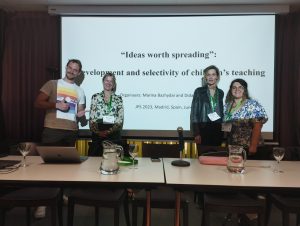
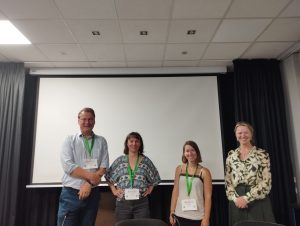
Didar, Elena and Marina presented at the Jean Piaget Society conference in Madrid held on 1-3 June.

Marina and Didar organised and presented at the symposium entitled “Ideas worth spreading: Development and selectivity in children’s teaching”, presenting work from the lab and international colleagues
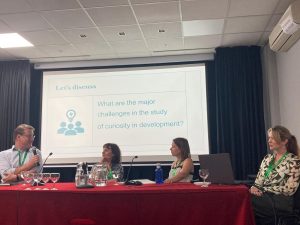
Marina organised the discussion session entitled “Conceptual and theoretical perspectives on curiosity in development” featuring a panel of international experts on curiosity, and Elena presented her work on infant curiosity.
STEM Engagement event at Quernmore school

Daphne and Marina ran an engagement event with children from Reception to Year 6 classes at the STEM week held at the Quernmore CofE primary school. Daphne spoke about what it is like to do psychological science, which methods we use in developmental research at the Babylab and Active Learning Lab, and offered interactive activities and lots of opportunities for asking questions and sharing experiences. We thank the school and children for hosting us!

ManyBabies collaborations – new pre-prints

Members of the lab have contributed to two large-scale international collaborations:

A Unified Approach to Demographic Data Collection for Research with Young Children Across Diverse Cultures is available as a pre-print here.
Here, we argue for an added emphasis on collecting detailed and high quality demographic data in developmental research and propose ways to do that.

ManyBabies 5: A large-scale investigation of the proposed shift from familiarity preference to novelty preference in infant looking time – pre-print here.
This is Registered Report proposing an investigation of the Hunter-Ames model of infant preferences for visual stimuli of different novelty and complexity.

Elena and Didar present at BCCCD’23

Elena Altmann and Didar Karadag presented their research at the Budapest CEU conference on cognitive development.
Elena presented her work on infants’ curiosity: Individual Differences in infants’ Exploration Styles within a novel, gaze-contingent Paradigm.
Didar presented on her work with toddlers: Selective teaching in development: preferential information transmission following direct instruction and independent exploration in 2-and 5-year-olds
and older children: Selective teaching: Do children transmit generalizable or specific information to naïve social partners?

New paper published!

Our new open-access publication entitled, Investigating the effect of synchronized movement on toddlers’ word learning, is out in Frontiers in Psychology journal.  We studied toddlers’ learning following a synchronous vs asynchronous interpersonal music and movement-based activity to learn if being in-sync with someone enhances learning outcomes. Contrary to our prediction, no such effect was detected, raising several explanations and exciting future directions.