Mathilde presented the ongoing work from the Curiosity Battery project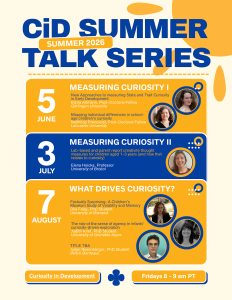 at the inaugural talk series of the Curiosity in Development Hub (CiD). CiD is a global research community of over 100 academics, cofounded and co-led by Marina and Mathilde, featuring regular talk series on curiosity, collaborative projects and thematic working groups: https://sites.google.com/view/curiosity-hub/about
Author: Marina Bazhydai
Early Years practitioner-academic workshop
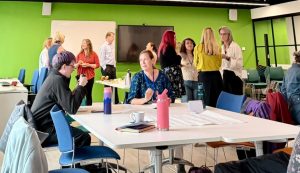
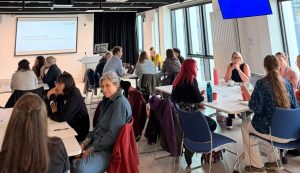
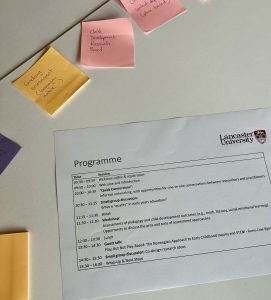 We hosted a full day workshop bringing together 25 participants from early years settings and academia to share experiences, discuss current challenges and opportunities in the sector, and identify priorities for future research. Through a series of interactive discussions, attendees explored topics including what constitutes quality in early childhood education, approaches to assessing child development, and ways to strengthen connections between research evidence and everyday practice. The highlight of the day was an invited talk by Dr Anne-Line Bjerknes from the University of South-Eastern Norway, who shared insights into the Norwegian approach to early childhood inquiry and STEM education.

New paper on children’s creativity and curiosity
In this new paper, we examined primary school children’s self-perceived creative pursuits in daily activities and looked at the relationship between children’s self-reported creativity and curiosity. We found that children’s responses fitted nine domains where creativity can be exercised, most frequently craft, DIY, and visual art. Domain-specific differences were present between “high” and “low” creative children and between boys and girls. Children’s self-reported creativity and curiosity were highly positively correlated. There were no pronounced gender differences except in creative pursuits’ domains
New paper on toddler’s communicative intentions
Our newly published paper on active learning and communication in infants and toddlers is now in Infancy journal: https://onlinelibrary.wiley.com/doi/10.1111/infa.70072
Led by Didar, this research documented how toddlers in the second year of life actively initiate interactions with their caregivers through different gestures (reach, point, give, hold out) and do so to meet a range of communicative goals, such as sharing interest, attention, or emotion, requesting an object or an action, seeking information or help, and even giving information. In sum, 1-2-year-olds communicate with others with increasingly complex intentions: to actively share, seek and transmit information to learn about the world.
New paper on curiosity and word learning in infants
New paper in Developmental Science! https://onlinelibrary.wiley.com/doi/full/10.1111/desc.70101
We find that infants just under 2 years of age are adept at learning new words – both in active and passive modes of learning. We did not find an advantage for word learning when children had a choice what to learn about over when the learning events were presented to them in a passive manner.
ALL joins the new ManyBabies Project on Infant Curiosity
We are excited to be a part of the new ManyBabies project – on infant curiosity. Learn more here: https://manybabies.org/MB7/
UK Curiosity Network Inaugural Workshop
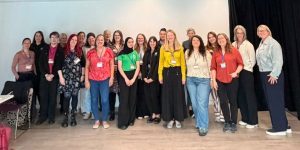
Dr Marina Bazhydai and Dr Mathilde Prenevost, in collaboration with Professor Candice Satchwell from the University of Lancashire, hosted the workshop on the study of curiosity funded by the Methods North West. It served as inaugural interdisciplinary workshop into the nature and study of curiosity, welcoming over 70 experts from across the UK to the collaborative event. The idea for the event was was borne out of the Leverhulme Trust funded project The Curiosity Battery, a five-year endeavour being jointly undertaken by Lancaster University and Dr Lily FitzGibbon at the University of Stirling to better understand and measure curiosity and how it impacts our wellbeing.
New paper on children’s teaching
New paper published in the special issue on Children’s teaching, Young Children’s Transmission of Information following Self-discovery and Instruction. Our study showed that children at the age of 2 tend to preferentially share information with someone who is less knowledgeable than them after they have been instructed themselves, rather after having learned it through independent exploration. However, 5-year-olds did not show such preference and tended to teach information both self-discovered and taught to them.
Imagination Cave at the Campus in the City

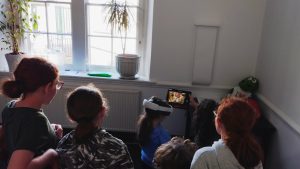
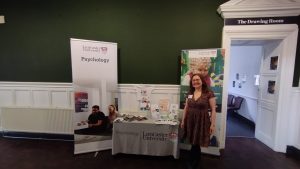
Marina and Mathilde presented the Imagination Cave – a VR experience public engagement exhibit presented at the annual Lancaster University run event, the Campus in the City, in collaboration with the ISS Innovation Hub. Over 50 members of the public visited the Imagination Cave!
Two new papers on infant curiosity
Elena Altmann, a formed PhD student, has published two of her papers this month on infant curiosity. Check them out:
Altmann, E. C., Bazhydai, M., Karadağ, D., & Westermann, G. (2025). The Infant and Toddler Curiosity Questionnaire: A validated caregiver-report measure of curiosity in children from 5 to 24 months. Infancy. https://onlinelibrary.wiley.com/doi/10.1111/infa.70001?af=R
Altmann, E. C., Bazhydai, M., Westermann, G. (2025). Curious Choices: Infants’ moment-to-moment information sampling is driven by their exploration history. Cognition. https://doi.org/10.1016/j.cognition.2024.105976