BEST: Blended Education for STEM Teaching
Engagement with science, technology, engineering, and mathematics (STEM) is crucial for both economic development and social well-being. Yet in many countries, including Malaysia, students’ interest in STEM often declines as they move from primary to secondary school. Research shows that hands-on, tangible learning experiences—such as those offered by the BBC micro:bit, a small programmable device used by over 44 million students globally—can spark curiosity, enhance problem-solving skills, and sustain motivation.
However, access remains a challenge in low-income communities. Although micro:bits are relatively affordable, they typically require a personal computer, which is often unavailable in schools within OECD Development Assistance Committee (DAC) countries. Many teachers therefore rely on “unplugged” activities (using pencil-and-paper or playground-based exercises), which can support abstract reasoning but lack the benefits of direct engagement with digital technology.
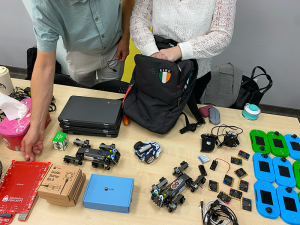
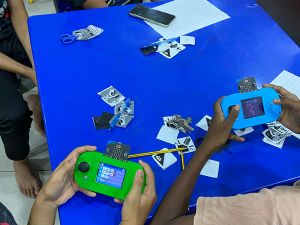
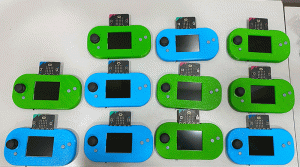
Project BEST addresses this gap by adapting MicroCode, a new learning tool that allows students to program and explore the micro:bit without needing a computer. Already tested successfully in two UK schools, MicroCode creates a bridge between unplugged activities and more advanced digital learning. Working closely with Malaysian educators, we will co-design and trial culturally relevant learning pathways that guide students from unplugged activities toward hands-on programming experiences as they enter lower secondary school.
The project’s outcomes include:
-
A tested and refined version of MicroCode adapted for Malaysian classrooms.
-
A progressive STEM learning pathway that builds from unplugged activities to digital interaction.
-
The establishment of a community of practice and a lending library, ensuring sustainable access for under-resourced schools.
Our methodological approach combines participatory design with local educators and empirical classroom evaluation, ensuring both contextual relevance and educational effectiveness. Ultimately, Project BEST aims to level the playing field for students in DAC countries, providing affordable, scalable ways to foster STEM engagement, strengthen problem-solving skills, and support equitable educational opportunities.
The first study started in Malaysia with the TICTAC team (Joe, Lorraine and Elisa) going there, and we are collecting very interesting data from children and teachers in schools.