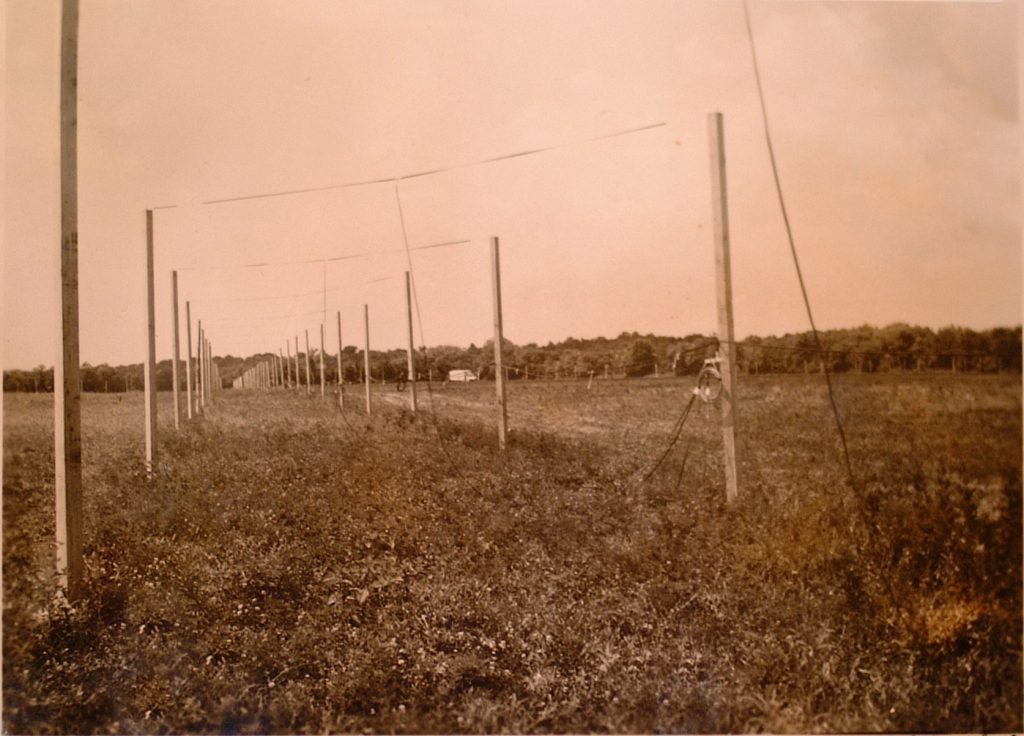
70 years ago, in a large field 20-miles west of Washington D.C., scientists Bernard Burke and Kenneth Franklin carefully strung up 5-miles of wire on a maze of wooden posts.
With this bare vineyard-like structure, Burke and Franklin had been attempting to survey the sky for known astronomical radio sources like the Crab Nebula but noticed a strong source of interference that passed overhead each day. Franklin joked that,
‘it was probably due to the faulty ignition of some farm hand returning from a date.’
But after several days of head-scratching, he started to plot the position of Jupiter in the sky.
‘As I plotted each point, Burke, who was watching over my left shoulder, would utter a gasp of amazement…The meaning was exquisitely clear: these events were recorded only when the planet Jupiter was in the confines of the narrow principal beam of the array.’
Using wooden posts and wire, and a HF receiver, they had discovered radio waves from another planet.
With the benefit of seven subsequent decades of observation and a golden age of satellite missions, we know now that Jupiter’s giant magnetosphere was the source of Burke and Franklin’s mysterious signals. Natural radio emissions have become a fundamental diagnostic in our exploration of planetary magnetospheres and even exoplanets. 2025 presents a unique opportunity when, 70 years on from Burke and Franklin’s original report of 1955, Jupiter sky viewing optimises in the northern hemisphere.
Members of the Space & Planetary Physics group at Lancaster University will this summer commemorate Burke & Franklin’s landmark experiment with a new radio telescope installation, attempting to hear Jupiter.