
Plastic Peril: The Devastating Impact on Tiger Sharks
by Lucy Harris
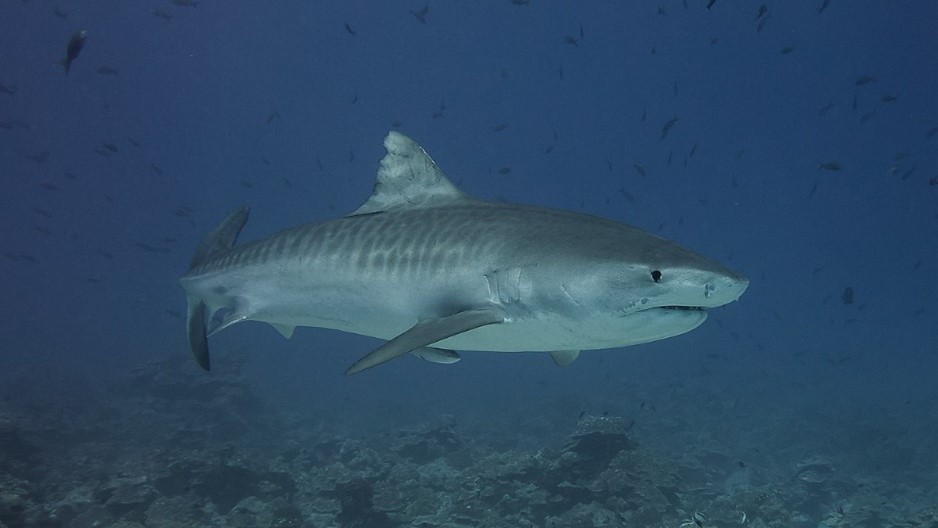
A Tiger shark (Galeocerdo cuvier)
Kris Mikael Krister, CC BY 3.0 <https://creativecommons.org/licenses/by/3.0>, via Wikimedia Commons
In 1965, a new global threat to the marine environment was documented by a plankton recording device as it became entangled in a plastic bag [1]. This was the first of many to come. Despite global actions to reduce plastic pollination [2], over 4.8 million tonnes of plastic waste were discarded into the ocean in 2010 [3]. This should raise concern as oceanic plastic can lead to severe and long-term impacts on the marine environment, and has been linked to a reduction in marine biodiversity [4]. However, the process in which plastic negatively impacts the ecosystem is still uncertain.
Afonso A.S and Fidelis L (2023) [5] focused on plastic entanglement on Tiger sharks (Galeocerdo cuvier), in order to understand the current relationship between marine megafauna and plastic debris. Megafauna play an important role in oceanic ecosystems by culling weak individuals, reducing diseases and balancing trophic levels [6]. However, plastic has been known to disrupt this essential ecological role, though entanglement and indigestion, often resulting in death [7].
This investigation took place in Northwest Brazil where tiger sharks were in high abundance. A total of 66 sharks were captured and any debris entanglement on them were recorded and removed [5]. A satellite tracker was also attached to a fin before they were released, allowing an observation into their swimming patterns and behaviour.
It was found that 3% of the specimens were severely entangled in debris mainly polypropylene plastic strappings tracked to local fisheries [5]. Deep lacerations, damaged fins and body deformation were noted, caused by the friction and stress of the strappings. One shark was found dead potentially as a result of the plastic restraints hindering its ability to hunt, self-protect and to move with ease.
There is also evidence that at least one shark had been coexisting with the plastic for years calculated from the average growth rate and the perimeter of the strappings [5]. Plastic entangled around the dorsal fin and stomach created a deformed body shape as the shark developed. Unfortunately, this shark passed away after the plastic removal, suggesting that the tight strappings were acting as a structural support to internal organs.
This observed proportion of severe entanglement in this study (3%) may be representative of the entire shark population which highlights the severe impact of irresponsible plastic use and disposal. Prey species will become unregulated causing a disrupted ecosystem and reduction of other fish species [8]. This will negatively affect cultures reliant on the fishing industry for income.
Ecosystems will contain less biodiversity as a result, and may cause a reduction of ecotourism losing revenue for some countries. The results hint that mitigation actions such as plastic disposal regulations would be the most effective due to the possibility of plastic removal inducing death. Overall plastic waste is one of the main threats to the global ecosystem with severe consequences to both humans and marine life.
References
[1] Ostle, C. et al. (2019) ‘The rise in ocean plastics evidenced from a 60-year time series’, Nature Communications, 10 (1), 1622. Available at: https://doi.org/10.1038/s41467-019-09506-1 (Accessed: 25 November 2023).
[2] Joyner, C and Frew, S (1991) ‘Plastic pollution in the marine environment’, Ocean Development & International Law, 22(1), 33-69. Available at: https://doi.org/10.1080/00908329109545949 (Accessed: 25 November 2023).
[3] Jambeck, J et al. (2015) ‘Plastic waste inputs from land into the ocean’, Science, 347 (6223), 768-771. Available at: https://doi.org/10.1126/science.1260352 (Accessed: 25 November 2023).
[4] Thushari, G and Senevirathna, J (2020) ‘Plastic pollution in the marine environment’, Heliyon, 6(8), e04709. Available at: https://doi.org/10.1016/j.heliyon.2020.e04709 (Accessed: 28 November 2023).
[5] Afonso, A.S. and Fidelis, L. (2023) ‘The fate of plastic-wearing sharks: Entanglement of an iconic top predator in marine debris’, Marine Pollution Bulletin, 194 (1), 115326. Available at: https://doi.org/10.1016/j.marpolbul.2023.115326 (Accessed: 24 November 2023)
[6] Motivarash Yagnesh, B. et all (2020) ‘Importance of sharks in ocean ecosystem’, Journal of Entomology and Zoology Studies, 8(1), 611-613. (Accessed: 27 November 2023)
[7] Gall, S.C. and Thompson, R.C. (2015) ‘The impact of debris on Marine Life’, Marine Pollution Bulletin, 92(1), 170–179. Available at: https://doi.org/10.1016/j.marpolbul.2014.12.041. (Accessed: 26 November 2023)
[8] Stevens, J. (2000) ‘The effects of fishing on sharks, rays, and Chimaeras (Chondrichthyans), and the implications for marine ecosystems’, ICES Journal of Marine Science, 57(3), 476–494. Available at: https://doi.org/10.1006/jmsc.2000.0724. (Accessed: 30 November 2023)