
Deforestation: The Greatest Threat Faced by Biodiversity
by Caitlin Healey
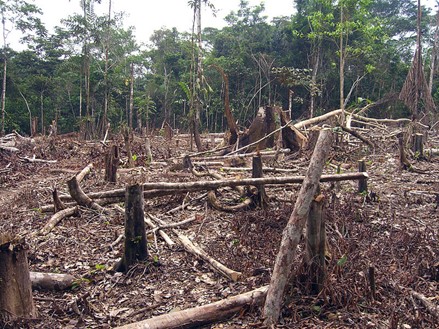
Amazon slash and burn agriculture deforestation, Colombia, South America Source: Matt Zimmerman, CC BY 2.0, via Wikimedia Commons
Deforestation is the intentional clearing of forested land for agricultural use, logging, or fuel, which is demonstrated in Figure 1.[1] It is one of the most widely known environmental challenges faced in the world today, acting as a major environmental and social concern. In 2021 the rate of deforestation was almost 22% higher than in 2020.[2] With time, we have seen the severity of this increasing as more of our rainforests are being depleted. But, to what extent is this the greatest threat faced by biodiversity?
The Great Threat! –
Wilcove et al., (2010) suggest that pressure points have different effects on biodiversity on different scales, specifically regarding palm oil. Pressure points are critical thresholds within the environmental system that, when put under stress, can cause catastrophic outcomes which are often irreversible.[3] Consequently, the demand remains consistently high for palm oil, having the greatest oil production levels in the world since 2018.[3] Hence, deforestation still occurs, threatening 54% of mammals globally.[4]
Multiple Causes of Deforestation –
Although Wilcove et al., (2010) focus on the effects of palm oil plantations on deforestation, there are many more larger-scale causes. For example, cattle grazing is escalating due to the surge in demand for meat with the increase of the middle class in developing countries, such as China.[5] It has now become the greatest cause of deforestation in the Amazon rainforest, accounting for 80% of all deforested land. [6] So, we can see that deforestation is caused by several issues. Therefore, we can argue that it is the greatest threat faced by biodiversity, as Wilcove et al., (2010) suggest, stating that human interference with the environment is the main cause of deforestation. [3]
Is Deforestation Still Threatening?
However, with 2021 experiencing an all-time high, this year has seen a decline leading to the lowest deforestation levels in 2 years.[7] This is largely due to new schemes being introduced. For example, $65 million was approved by the Brazilian government from The Amazon Fund to police the rainforest.[8] This scheme will prevent illegal logging activity from occurring in the future, working towards maintaining this decrease in deforestation for the foreseeable future. This is a major improvement as it is estimated that 94% of deforestation in the Amazon involves illegal activity, accounting for 18 million hectares of habitats.[9] We can already see the influence this has had on reducing deforestation by the levels experienced this year.[7]
Conclusion
Essentially, slowing down the process has not yet made up for the significant loss of trees we have caused the forest. Ultimately, to replenish it back to substantial levels, afforestation must occur, returning the habitats to the millions of species fighting for survival. Furthermore, there is great reason for us to fight back against the destruction of these habitats for the sake of the survival of animals. But, despite some steps being made to reduce deforestation, the effects are still being felt. Therefore, I believe that it is the greatest threat faced by biodiversity today.
Bibliography:
[1] The National Geographic Society (2022), Deforestation. [online] Available at: https://education.nationalgeographic.org/resource/deforestation/. [30/11/23]
[2] InfoAmazonia (2021), Deforestation in the Legal Amazon grows 22% in 2021, reaching the highest rate in 15 years. [online] Available at: https://infoamazonia.org/en/2021/11/19/deforestation-amazon-grows-22-in-2021/. [29/11/23]
[3] Wilcove, David S, and Lian Pin Koh. (2010). ‘Addressing the Threats to Biodiversity from Oil-palm Agriculture’. Biodiversity and Conservation 19 (no. 4), pp. 999-1007. [29/11/23]
[4] IUCN (2018), Palm oil and biodiversity. [online] Available at: https://www.iucn.org/resources/issues-brief/palm-oil-and-biodiversity. [01/12/23]
[5] Latawiec, A. E., B. B. N. Strassburg, J. F. Valentim, F. Ramos, and H. N. Alves-Pinto. (2014). ‘Intensification of Cattle Ranching Production Systems: Socioeconomic and Environmental Synergies and Risks in Brazil’, Animal (Cambridge, England), 8(no. 8), pp. 1255-263. [01/12/23]
[6] WWF (2020), Unsustainable Cattle Ranching. [online] Available at: https://wwf.panda.org/discover/knowledge_hub/where_we_work/amazon/amazon_threats/unsustainable_cattle_ranching/ [01/12/23]
[7] Hawkinson, K. (2023), ‘Brazil could reach all-time lowest deforestation rates within 2 years’, The Independent. [online] Available at: https://www.msn.com/en-gb/news/world/brazil-could-reach-all-time-lowest-deforestation-rates-within-two-years/ar-AA1kuqbM [29/11/23]
[8] CNA (2023), Brazil approves 65 million from Amazon Fund to police the rainforest. [online] Available at: https://www.channelnewsasia.com/sustainability/brazil-approves-65-million-amazon-fund-police-rainforest-deforestation-3940461 [01/12/23]
[9] Hussain, G. (2023), ‘Amazon Deforestation – How Much of the Rainforest Is Left?’, The Brazilian Institute of the Environment and Renewable Natural Resources. [online] Available at: https://sentientmedia.org/amazon-deforestation/#:~:text=Estimates%20suggest%2094%20percent%20of%20deforestation%20in%20the [29/11/23]