
Aquaculture Anarchy: How Chemical and Antibiotic Abuse in Bangladesh Could Limit Global Food Security.
by Will Burke
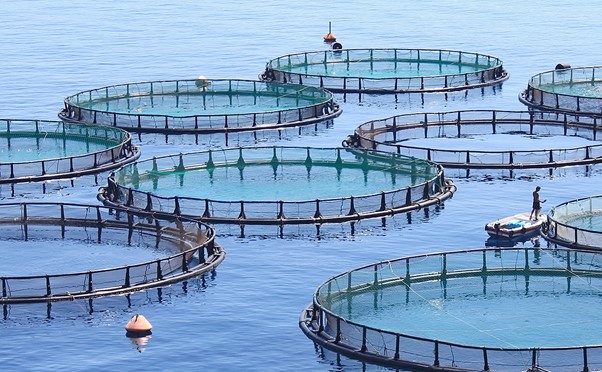
Figure 1: Ring net offshore aquaculture. Image: Asc1733, CC BY-SA 4.0 <https://creativecommons.org/licenses/by-sa/4.0>, via Wikimedia Commons.
A decade ago aquaculture – fish and aquatic plant farming [1] – surpassed capture as the primary source of global seafood [2] with the production rate now exceeding 110 million tonnes per year [3]. Aquaculture is therefore becoming increasingly important for both global food security [4] and the economies of several nations [5-7]. This growing reliance on aquaculture has intensified research in several areas including microplastics [8], escape [9], and production improvements [10], however, a recent paper from the Sylhet Agricultural University Bangladesh has considered the prevalence of industry substances alongside their impacts on not only fish but farmers, consumers, and the environment too [11].
The study focused on Narsingdi, Bangladesh given the nation’s aquaculture efforts – Bangladesh ranks as the world’s 5th aquaculture producer by ton [3], and exports to over 50 countries [12], giving the quality of their fish international importance – alongside limited existing research on the Narsingdi district [11]. The study identified various substances used in Narsingdi aquaculture, and alarmingly haphazard antimicrobial and chemical use which could negatively impact future aquaculture and human health [11].
The potential implications for future aquaculture and the wider environment were discussed, with the risk of fish developing antibiotic resistance through antibiotic misuse carefully considered [11]. In these cases, bacteria can becomes resistant to treatment, increasing fish vulnerability to illness [13, 14], reducing yields [15] which could increase prices and lower food security through reduced economic access. The inappropriate use of chemicals due to limited understanding, poor regulation, and incorrect application [11] is also a cause for concern as some contribute to increased mortality for non – target species – such as crustaceans [16] – which are vital to food chain stability [17], while others – like chlorine [11] – deal significant damage to the local environment through soil pollution [18], reducing agricultural opportunities [19], further limiting food security.
The human implications of the findings were also considered by linking aquaculture substances to potential health complications [11]. It was found that some substances remain in the food system via exposure pathways, potentially impacting farmers, handlers, and consumers [11]. Through a literature review, specific impacts were explored. Antimicrobial agents were linked to human antibiotic resistance, potentially reducing treatment efficacy, disinfectants to cancer, and pesticides to heart failure, cancer, and hypertension [11]. Alongside general well-being impacts, poor health can also reduce productivity [20], potentially further reducing food security through lower aquaculture outputs.
Aquaculture is increasingly important to food security, from the local [21] to the global [4, 12] scale. It must however pivot to more sustainable approaches – as spearheaded by nations like China through their increasing use of organic aquaculture [22], which offers reduced pesticide and antibiotic use compared to current approaches [23] – maintaining productivity without risking future aquaculture efforts or the health of people and places throughout the global food system.
Reference List:
- NOS (2023) What is aquaculture? https://oceanservice.noaa.gov/facts/aquaculture.html#:~:text=Aquaculture%20is%20breeding%2C%20raising%2C%20and,of%20threatened%20or%20endangered%20species. [22.11.23].
- Roser, H.R.a.M. (2021) Fish and Overfishing. https://ourworldindata.org/fish-and-overfishing#article-citation [20.11.23].
- OECD (2023) Aquaculture Production (Indicator). https://data.oecd.org/fish/aquaculture-production.htm [20.11.23].
- Pradeepkiran, J.A. (2019) Aquaculture role in global food security with nutritional value: a review. Translational Animal Science 3, 903-910.
- Economics, B. (2020) Estimation of the Wider Economic Impacts of the Aquaculture Sector in Scotland. https://www.gov.scot/publications/estimation-wider-economic-impacts-aquaculture-sector-scotland/ [21/11/23].
- Johansen, U., H. Bull-Berg, L.H. Vik, A.M. Stokka, R. Richardsen, and U. Winther (2019) The Norwegian seafood industry – Importance for the national economy. Marine Policy 110.
- Godfrey, M. (2019) Massive shift underway in China’s aquaculture, fisheries sectors. https://www.seafoodsource.com/news/supply-trade/massive-shift-underway-in-china-s-aquaculture-fisheries-sectors [22.11.23].
- Chen, G., Y. Li, and J. Wang (2021) Occurrence and ecological impact of microplastics in aquaculture ecosystems. Chemosphere 274.
- Føre, H.M. and T. Thorvaldsen (2021) Causal analysis of escape of Atlantic salmon and rainbow trout from Norwegian fish farms during 2010–2018. Aquaculture 532.
- Khanjani, M.H. and M. Sharifinia (2020) Biofloc technology as a promising tool to improve aquaculture production. Reviews in Aquaculture 12, 1836-1850.
- Kawsar, M.A., M.T. Alam, D. Pandit, M.M. Rahman, M. Mia, A. Talukdar, and T.A. Sumon (2022) Status of disease prevalence, drugs and antibiotics usage in pond-based aquaculture at Narsingdi district, Bangladesh: A major public health concern and strategic appraisal for mitigation. Heliyon 8, 09060.
- Desk, F.O. (2023) Bangladesh exports fish and fish products to over 50 countries. https://thefinancialexpress.com.bd/trade/bangladesh-exports-fish-and-fish-products-to-over-50-countries [21.11.23].
- Yu, J.E., M.Y. Cho, J.-w. Kim, and H.Y. Kang (2012) Large antibiotic-resistance plasmid of Edwardsiella tarda contributes to virulence in fish. Microbial Pathogenesis 52, 259-266.
- Sherif, A.H., M. Gouda, S. Darwish, and A. Abdelmohsin (2021) Prevalence of antibiotic-resistant bacteria in freshwater fish farms. Aquaculture Research 52, 2036-2047.
- Santos, L. and F. Ramos (2018) Antimicrobial resistance in aquaculture: Current knowledge and alternatives to tackle the problem. International Journal of Antimicrobial Agents 52, 135-143.
- Parsons, A.E., R.H. Escobar-Lux, P.N. Sævik, O.B. Samuelsen, and A.-L. Agnalt (2020) The impact of anti-sea lice pesticides, azamethiphos and deltamethrin, on European lobster (Homarus gammarus) larvae in the Norwegian marine environment. Environmental Pollution 264, 114725.
- Szaniawska, A. (2018) Function and Importance of Crustaceans. In: Baltic Crustaceans, New York: Springer, 185-188.
- Parveen, N., S. Chowdhury, and S. Goel (2022) Environmental impacts of the widespread use of chlorine-based disinfectants during the COVID-19 pandemic. Environmental Science and Pollution Research 29, 85742-85760.
- Geilfus, C.-M. (2019) Chloride in soil: From nutrient to soil pollutant. Environmental and Experimental Botany 157, 299-309.
- Mitchell, R.J. and P. Bates (2011) Measuring health-related productivity loss. Popul Health Manag 14, 93-8.
- Irwin, S., M.S. Flaherty, and J. Carolsfeld (2021) The contribution of small-scale, privately owned tropical aquaculture to food security and dietary diversity in Bolivia. Food Security 13, 199-218.
- Xie, B., J. Qin, H. Yang, X. Wang, Y.-H. Wang, and T.-Y. Li (2013) Organic aquaculture in China: A review from a global perspective. Aquaculture 414-415, 243-253.
- Cottee, S.Y. and P. Petersan (2009) Animal Welfare and Organic Aquaculture in Open Systems. Journal of Agricultural and Environmental Ethics 22, 437-461.