
How Citizen Science can teach you something new and improve your mental health
By Anna Foster
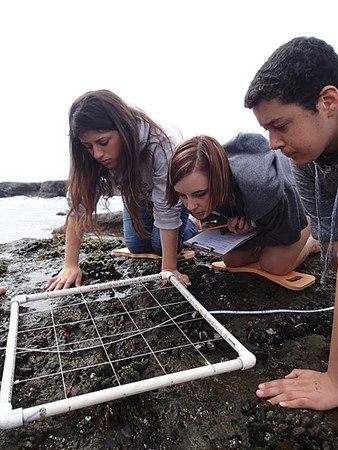
Young people conducting a rocky shore survey as part of a citizen science project. (Photograph by National Marine Sanctuaries, public domain.
Citizen science is “Scientific work undertaken by members of the general public” without any specified level of education or training [1] meaning that anyone can contribute to research in this way.
It is a method used by many charities, communities, and other organizations to help aid with data collection – you can find citizen science opportunities to get involved with through: the Royal Society for the Protection of Birds RSPB [2], the Hebridean Whale and Dolphin Trust (HWDT) [3], the UK Centre for Ecology and Hydrology (UKCEH) [4] and many more! It has many benefits: use along with traditional scientific data to fill in data gaps, improve public engagement and education, widen access to science, give communities a voice and environmental justice [5,6]. There is also potential for nature-based citizen science to improve our mental health and well-being [7].
There is a link between connecting with nature and improved mental health [7,8]. This is something you may feel when walking in a park and noticing the nature around you. But we are increasingly disconnected with nature due to urbanisation and this impacts both our mental health and our empathy for nature – meaning we are less likely to want to conserve nature if we are disconnected from it [5]. Activities to encourage connection with nature are hence very important.
There are many different methods whereby we can connect with nature and citizen science projects could be one. For example, the RSPB’s Big Garden Birdwatch encourages people to count the number of each species of bird in their garden or a local park over an hour period – the RSPB state on their website “people taking part in Big Garden Birdwatch for the first time often find it sparks a passion for nature” [2]. If you’re interested, this is a citizen science project you could try!
Citizen science most certainly does encourage connection with nature and improve mental health even over short periods [7]. But is citizen science as effective at improving wellbeing and connection with nature as other methods such as more reflective methods?
In a short-term study that encouraged citizen science activities, “nature-noticing” activities or a combination, all three activities were found to improve feelings of nature connectedness [7]. The citizen science activity had the bonus of making participants feel as if they were learning from the task as well as helping to conserve nature. However, the “nature-noticing” activity was more relaxing for participants and less likely to cause “frustration” whereas the citizen science activity had a higher dropout rate [7]. The potential frustration with science-based activities could potentially be improved by simplifying survey techniques to make them more accessible to the general public.
Citizen science has limitations like any other scientific data but with such an array of other benefits it’s hard to argue we shouldn’t be using citizen science as a tool for data collection, wellbeing, learning and empowerment. We should all be citizen scientists!
References:
[1] citizen science, n [Internet]. Oxford University Press; 2013 [cited 2023 Nov 23]. Available from: https://www.oed.com/dictionary/citizen_n
[2] Big garden birdwatch [Internet]. [cited 2023 Nov 23]. Available from: https://www.rspb.org.uk/whats-happening/big-garden-birdwatch
[3] Hebridean whale and Dolphin Trust [Internet]. HWDT; [cited 2023 Nov 23]. Available from: https://hwdt.org/
[4] Citizen science [Internet]. UKCEH; [cited 2023 Nov 23]. Available from: https://www.ceh.ac.uk/citizen-science
[5] Schuttler SG, Sorensen AE, Jordan RC, Cooper C, Shwartz A. Bridging the nature gap: Can citizen science reverse the extinction of experience? Frontiers in Ecology and the Environment. 2018;16(7):405–11. doi:10.1002/fee.1826
[6] De Sherbinin A, Bowser A, Chuang T-R, Cooper C, Danielsen F, Edmunds R, et al. The critical importance of Citizen Science Data. Frontiers in Climate. 2021 Mar 25;3:1–7. doi:10.3389/fclim.2021.650760
[7] Pocock MJ, Hamlin I, Christelow J, Passmore H, Richardson M. The benefits of citizen science and nature‐noticing activities for well‐being, nature connectedness and pro‐nature conservation behaviours. People and Nature. 2023 Jul 8;5(2):591–606. doi:10.1002/pan3.10432
[8] Martin L, White MP, Hunt A, Richardson M, Pahl S, Burt J. Nature contact, nature connectedness and associations with health, wellbeing and pro-environmental behaviours. Journal of Environmental Psychology. 2020 Jan 18;68:1–12. doi:10.1016/j.jenvp.2020.101389