
Wildflower stips: a road map to restoring wild bee populations
By Isabelle Fallows
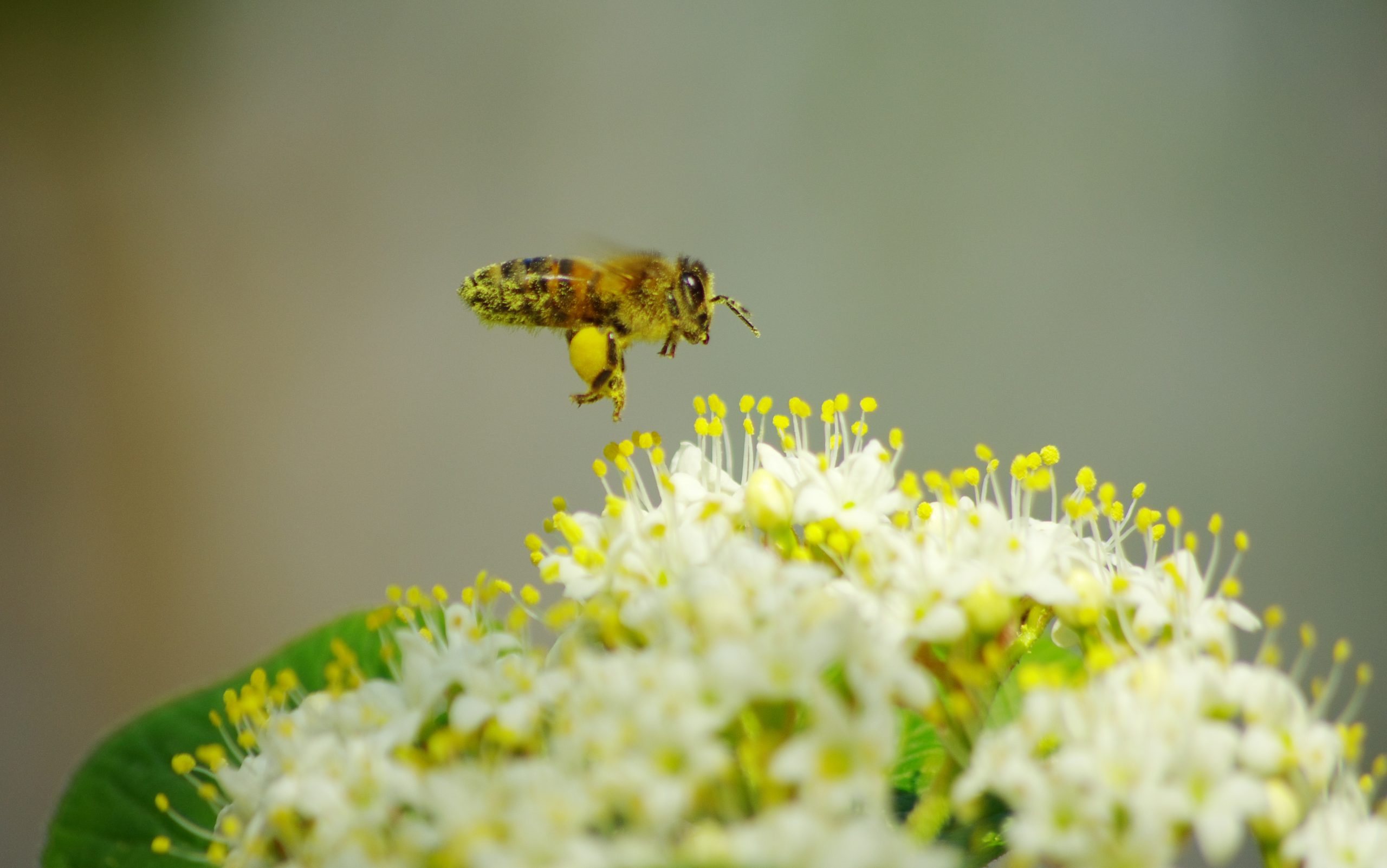
A bee collecting pollen
It has been found that 70% of leading global crops benefit from pollination (Figure 1) due to increased yield and quality [1]. This is critically important for the global agricultural system as it increases the system’s efficiency due to higher yields for the area and reduces waste. However, the ever-increasing intensification of the agricultural system in attempts to satisfy the growing global population is causing the fragmentation of wild bee habitats, leading to declining populations [2]. Hope is not all lost, as recent research has shown that wildflower strips have successfully increased the reproductive success of wild bee species [3], potentially providing a highly needed method to counteract the impact of changing land use.
Benefits of wildflowers for bees
The study by Ganser et al.(2020) [3] looked at populations of solitary bees that consisted of various body sizes in three different habitats: wildflower strips, forest edges and locations that were not close to either of the previous habitats (isolated). It found that the journey lengths for bees foraging in the wildflower strips were significantly shorter within all studied species compared to those in the isolated areas [3]. This would reduce predation risk as they are exposed for a shorter period. Furthermore, the reproductive success of both foraging and nesting bee species was also increased in the wildflower strip (an increase of 60% from isolated habitats)[3]. However, it was also noted in the study that species with a smaller body size benefited the most from the wildflower strip. This could reduce their impacts as larger-bodied bees are more functionally efficient (play an irremovable role within the ecosystem) and also more prone to extinction [3,4].
Not just for bees
Additionally, wild bees are not the only ones who benefit from wildflowers; in fact, they only made up 25% of the total visitors observed in a study carried out in 2016 [5]. The remaining species provide useful ecosystem services, even if they receive much less credit for it from the public consciousness. Several European countries have implemented this conservation tool, although it is worth considering that there is no standardised mix of flower and grass species [6], therefore the extent to which wildflower strips increase reproductive success may vary from site to site.
Other factors causing declining populations
On the other hand, the intensification of agriculture is not the only factor driving the decline of wild bee populations. A recent study found that as the abundance of honey bees (Apis mellifera) increased, the diversity of wild bee species decreased [7]. This is concerning, especially for urban wild bee populations where domestic honey bee keeping is becoming increasingly popular.
Conclusion
In short, implementing wildflower strips within agricultural landscapes can mitigate declines in wild bee populations due to increasing individual reproductive success [3]. This is extremely important as wild bees are vital for the efficient functioning of the agricultural system [1]; wildflowers may pave the road to more sustainable farming.
Word count: 498
References:
[1] Ricketts, T., Regetz, J., Steffan-Dewenter, I., Cunningham, S., Kremen, C., Bogdanski, A., Gemmill-Herren, B., Greenleaf, S., Klein, A., Mayfield, M., Morandin, L., Ochieng’, A., Viana, B. (2008) ‘Landscape effects on crop pollination services: are there general patterns’, Ecology Letters, 11, 499–515.
[2] Holzschuh, A., Steffan-Dewenter, I. and Tscharntke, T. (2010) ‘How do landscape composition and configuration, organic farming and fallow strips affect the diversity of bees, wasps and their parasitoids?’, Journal of Animal Ecology, 79, 419-500.
[3] Granser, D., Albrecht, M. and Knop, E. (2020) ‘Wildflower strips enhance wild bee reproductive success’, Journal of Applied Ecology, 58, 486-495.
[4] Larsen, H., Williams, M. and Kremen, C. (2005) ‘Extinction order and altered community structure rapidly disrupt ecosystem functioning’, Ecology Letters, 8, 538–547.
[5] Grass, I., Albrecht, J., Jauker, F., Diekötter, T., Warzecha, D., Wolters, V. and Farwig, N. (2016) ‘Much more than bees—Wildflower plantings support highly diverse flower-visitor communities from complex to structurally simple agricultural landscapes’, Agriculture, Ecosystems & Environment, 225, 45–53.
[6] Haaland, C., Naisbit, E. and Bersier, L. (2010) ‘Sown wildflower strips for insect conservation: a review’, Insect Conservation and Diversity, 4, 60–80.
[7] MacInnis, G., Normandin, É. and Ziter, C. (2023) ‘Decline in wild bee species richness associated with honey bee (Apis mellifera L.) abundance in an urban ecosystem’, PeerJ, 11, e14699.
[8] [1], CC BY 3.0 <https://creativecommons.org/licenses/by/3.0>, via Wikimedia Commons