
Tackling the UN’s Sustainable Development Goals through beekeeping
By Lera Peretiatko
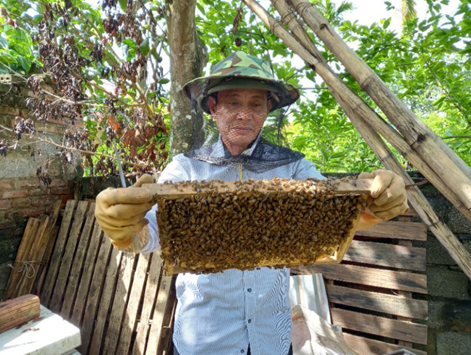
Vu Tan Suu is inspecting the bees on a light, removable frame. He is making more money now after training in beekeeping, from a similar project taking place in Vietnam. [9]
The United Nation’s (UN) has set out 17 Sustainable Development Goals and beekeeping could just be the answer to over a third of them [1]. Such as targets to end poverty, promote wellbeing at all ages and achieve gender equality. Yap et al., (2015) explored the development benefits from beekeeping introduced in Ha Tinh, one of the poorest provinces in Vietnam, as part of The Beekeeping Development and Rural Extension Project [2]. In traditional Vietnamese beekeeping, log and top-bar hives are used [3]. However, these hives must be cut into to collect the honey and consequently bees abandon their hives. Although traditional, it reduces the amount of honey produced and is not a sustainable practice when thinking about the longevity of a colony [2]. Beekeeping training during this 5-year project firstly involved the introduction of light, movable frames (see figure 1). Also, workshops about how to inspect the hives for diseases, queen rearing, colony lifecycles and more. After the training, participants were given a Beekeeping Manual and two beehives with the Eastern honey bee (Apis cerana L) and the Giant honey bee (Apis dorsata L) where both are native Vietnamese bee species. [2]
The results? Increased household income, improved familiar relationships as well as health. 63% of farmers earned more than $200 per year, which more than quadrupled the original target of 15%. Over the 6 communities involved, an average 37% shift was seen towards more equal household task distribution. Additionally, a rather unexpected result occurred, with 76% of participants stating their quality of life improved significantly; “When I come home from the farm at the end of a hard day and I see the bees, I feel so happy” [1].
Evidently, beekeeping whether directly (through increasing household income) or indirectly (promotion of wellbeing), serves multiple advantages. Researchers have proposed 6 essential elements that lead to wellness [4]. These include environmental mastery, positive relationships with others and personal growth. According to the UN, almost 1 billion people struggle with mental health i.e., anxiety and depression [5], so could beekeeping be part of the solution?
Having interesting stimuli and participating in a meaningful activity, like beekeeping, can help overcome mental fatigue [6]. Another project “Bee Inspired”, trialled beekeeping as a strategy to help young offenders. Results were very positive, with only 6% re-offending after 18 months (it’s important to note, those that re-offended did not continue beekeeping) [7]. Also, beekeeping is a suitable activity for a wide range of ages and physical abilities, allowing people to connect with nature, themselves and provides opportunities for social interaction and community building [8]. This has inspired the bloom of nature-based interventions i.e., people struggling with mental health are given community-based support through interacting with nature.
In summary, we have a lot to gain from beekeeping and possibly more to unlock! The promotion of such practice also helps support the pollinators, which is especially crucial now in the face of climate change.
References:
[1] UN DESA. 2018. The Sustainable Development Goals Report 2018 – July 2018. New York, USA: UN DESA.
[2] Yap, Nonita, John F Devlin, Gard Otis, Thang Van Dang, and Hang Thi Nguyen. (2015) “Beekeeping, Wellbeing, Transformative Change: Development Benefits According to Small Farmers in Vietnam.” Journal of Rural and Community Development 10, no. 1, 19.
[3] Crane. E (1971) Frameless movable-comb hives in beekeeping development programmes. Bee World, 52, 33-37.
[4] Camfield, L., Choudhury, K., & Devine, J. (2009). Wellbeing, happiness, and why relationships matter: Evidence from Bangladesh. Journal of Happiness Studies, 10(1), 71-91.
[5] UN News (2022) Nearly one billion people have a mental disorder: WHO. https://news.un.org/en/story/2022/06/1120682 [25/11/2023]
[6] Kaplan, R. and Kaplan, S. (1989) The experience of nature: A psychological perspective. Cambridge; New York: Cambridge University Press.
[7] Tierney, P. (2012) ‘A comparative study of beekeeping as an intervention with troubled young people’. PhD Thesis. University of Bedfordshire.
[8] Sarah H. Whitaker. Tranquil and Serene: Beekeeping and Well-Being in the Italian Alps. Ecopsychology. Jun 2023. 160-171.
[9] UNDP (2021) Sweet Success by UNDP Climate. https://undp-climate.exposure.co/gcf-vietnam [25/11/2023]