Natures in Translation: AI, Ethics and Environmental Conservation
Lancaster University, UK
1-2 October 2026
Conference funded by the Arts and Humanities Research Council and BRAID
Abstract submission deadline: 30 April 2026
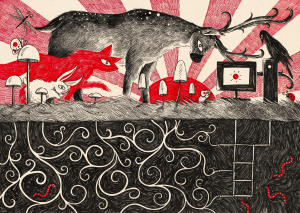
Illustration @Mollie Ray.
Confirmed keynote speakers: Prof. Ursula K. Heise (UCLA), Dr. Eva Meijer, Prof. César Rodríguez-Garavito (NYU), Prof. Şebnem Susam-Saraeva (Edinburgh University).
Confirmed keynote performance: Khairani Barokka
The question of who can speak on behalf of the more-than-human world has been central to the development of environmental studies as well as animal and plant studies. As new AI technologies promise to translate animal and plant communications into human language(s), these questions are also of increasing importance to biologists, ethologists, humanities scholars and animal conservation actors. In their promotional and public-facing discourse, AI initiatives such as Earth Species Project and Cetacean Translation Initiative (CETI) envision a future where humans might bridge the communication gap between themselves and non-human species with AI technologies. The intellectual, corporate and media narratives articulated around the generative AI technologies involved promise not only to improve human understanding of the natural world, but to also catalyze a cultural shift in how we interact with non-human species and the environment. This interdisciplinary conference explores the ethical implications of AI-assisted animal translation for environmental conservation and human-environmental relations. How might the use of AI to translate more-than-human communication help or hinder environmental conservation practices within a multispecies justice framework?
At this conference, we invite perspectives from translation studies, animal behaviour science, philosophy, law, literature, computer science, social science, digital humanities and related fields to address urgent questions relating to the use of AI for environmental conservation purposes. Who has authority to speak for animals? How do these technologies extract, process and interpret data, and what assumptions do they embed about animal communication? Do they serve multispecies justice or reinforce anthropocentric perspectives? What might a more expansive understanding of “listening” at the intersection of environmental conservation, translation studies, critical AI studies and media theory entail? What broader inter-disciplinary framework and collaborations can be developed to tackle these important epistemological, ethical, and ecological questions?
Target Audience
This AHRC BRAID-funded conference aims to build bridges between science, humanities and social science scholars, as well as practitioners working in conservation, animal welfare, AI development, animal studies, and environmental advocacy. We particularly welcome contributions that engage across disciplinary boundaries and that bring critical and creative perspectives to bear on emerging technologies.
A non-exhaustive list of possible presentation topics includes:
Interspecies Communication: Science, Ethics and Translation
- Current understanding of animal and plant communication systems (cognition, vocalizations, chemical signaling, mycelial networks)
- Translation studies perspectives on rendering animal/plant communication legible to humans
- Historicising scientific histories of human-animal communication
- Critiques of anthropomorphism in interspecies translation
Critical Perspectives on AI Translation Technologies
- Algorithmic logics , data extraction, and the commodification of animal bioacoustic data
- Implications for AI-assisted animal translation for critical AI and data studies and digital humanities
- Corporate interests and the governance of AI animal translation projects
- Transparency, accountability, and the environmental costs of large-scale AI models
- Media narratives and public discourse around AI-assisted animal translation
- Philosophical and legal questions: animal rights, personhood, consent, and agency in relation to communication technologies
Indigenous Knowledge and Decolonial Approaches
- Indigenous perspectives on interspecies communication and relationality
- Place-based ecological knowledge and translation in the age of AI
- Questions of sovereignty, land rights, and authority to interpret more-than-human communication
- Reciprocity, accountability, and Indigenous AI and human/more-than-human protocols
Creative Methods, and Interdisciplinary Futures
- Literary, artistic, and speculative approaches to interspecies communication (creative writing, sound art, film, performance)
- Practice-based and arts-based methodologies for engaging with more-than-human worlds
- Literary, artistic and digital/computational representations of more-than-human voices
Conservation Practice and Policy
- Case studies of AI deployment in conservation contexts
- The potential benefits and risks of AI translation for endangered species protection
- Community-based conservation and local knowledge systems
- The relationship between technological innovation and material conservation action
Guidelines:
Abstract length: 250–300 words
Bio: 100–150 word
Format: Word or PDF, submitted to: naturesintranslation@lancaster.ac.uk
Abstract submission deadline: 30 April 2026
Notification of acceptance: 18 May 2026 (extended to 30th of May due to abstract deadline extension)
Conference: 1-2 October 2026